CORE DISTORTION: THERAPEUTIC SEDATION
20 Nov 2026
The cosmos is not a weighted blanket for modern anxiety
20th November: Behold, Now As Ever | Reducing Cosmic Uniformity to a Stress-Relief Blanket
THE DUAL-TRANSLATION HEADER
The Text in Question
The Daily Stoic Rendering
“If you’ve seen the present, you’ve seen all things, from time immemorial into all of eternity. For everything that happens is related and the same.” - Marcus Aurelius, Meditations, 6.37
Standard Academic Translation
“Whoever has seen the present has seen all things, both all that has come to pass from eternity and all that will be throughout infinite time; for all things are of one kind and of the same form.” - Meditations, 6.37 (trans. Robin Hard)
ACADEMIC CONTEXT & BREAKDOWN
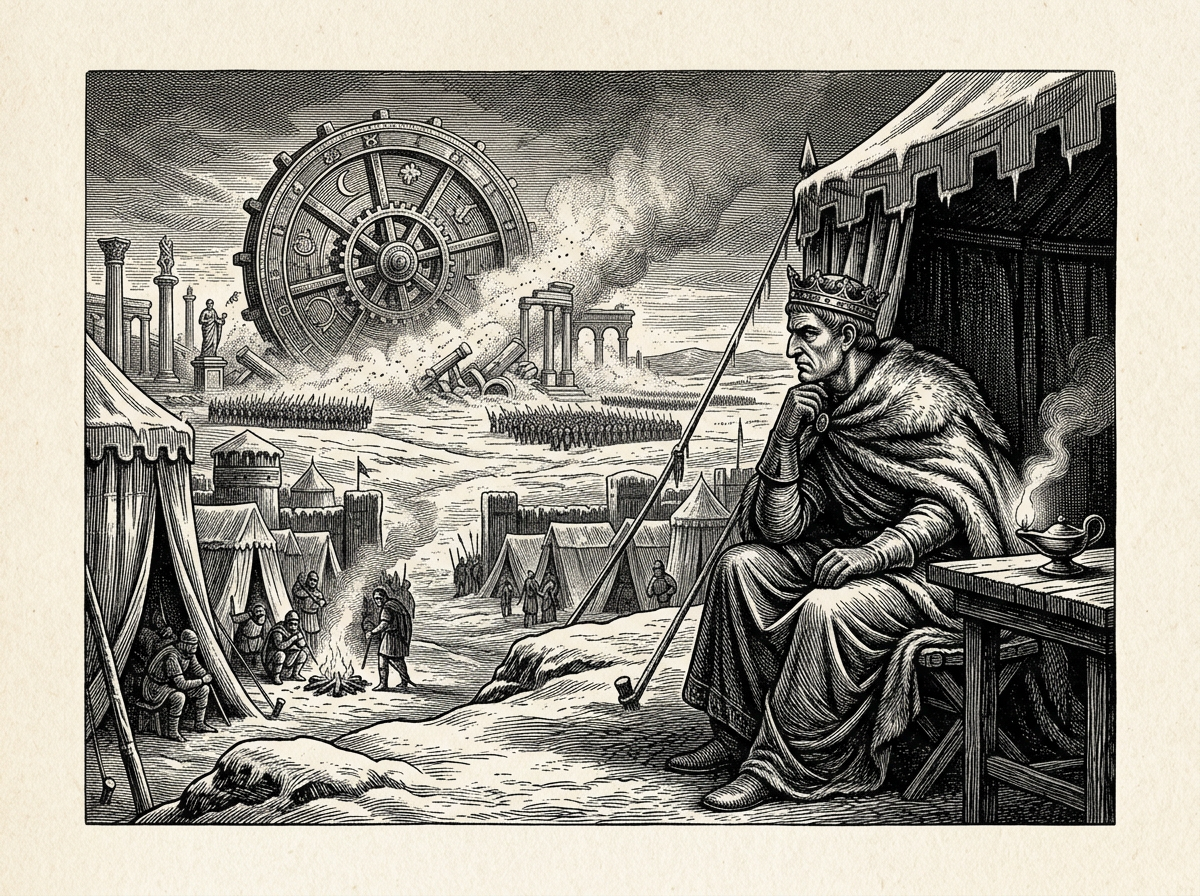
Marcus Aurelius penned these lines by sputtering lamplight in a sodden, frost-bitten military outpost along the Danube, his body wrecked by chronic chest spasms, insomnia, and the unrelenting miseries of the Marcomannic Wars. He was surrounded by the stench of burning pyres as the Antonine plague tore through his legions, while imperial couriers delivered steady reports of rebellion, assassination plots, and political betrayal from Rome. Stripped of all romantic illusions about his purple robes, he sat alone with his journal to perform brutal surgery on his own ego before the vastness of time crushed his resolve.
In Hard’s academic translation, Marcus is not invoking a comforting cycle of nature to soothe frayed nerves, but confronting the austere physical determinism of the Stoic cosmos. Universal Nature operates according to an unbroken chain of cause and effect, repeating identical formal patterns (homoeidē) across infinite cyclical time. Because every human drama, war, triumph, and tragedy shares the exact same fleeting, perishable form, nothing in mortal existence possesses novel grandeur or lasting importance meaning that chasing legacy, fearing death, or being captivated by the spectacles of life is total irrational vanity.
THE OPENING COUNTER-PUNCH
The commentary guts Marcus’s severe ontological demolition of human vanity and degrades it into an emotional sedative for the chronically anxious. It takes an emperor’s weapon against pride and twists it into a cozy reassurance that your daily routine is just part of a gentle, picturesque universe. Cosmic determinism is sanitized into a cheap mindfulness trick designed to grant middle-class relief.
THE BREAKDOWN
- The Sentimental Poeticizing of Doom — The commentary softens Marcus’s stark ontological axiom into romantic nature writing about “animals living and dying, clouds rolling in and rolling out, air sucked in and sucked out, as it has for aeons.” Marcus was not sitting in a meadow admiring the rhythmic respiration of the biosphere; he was staring down slaughter, pestilence, and the inevitable decay of his own flesh. Dressing up an existential weapon meant to strip mortal events of their false allure as a poetic meditation on nature fundamentally alters Marcus's rigorous physics into soft sentimentalism, which is entirely unauthentic.
- The Theological Hijacking into Christian Liturgy — The modern writer evades Marcus’s pagan, cyclical determinism by declaring that “this idea is expressed nowhere more beautifully than in the Christianity hymn Gloria Patri.” The Gloria Patri is a Trinitarian hymn of eternal divine worship and personal salvation, which stands in direct contradiction to Marcus's vision of an impersonal cosmos that repeatedly consumes and recycles all matter without individual deliverance. Pasting Christian liturgical comfort over an uncompromising pagan meditation on endless repetition mutates Marcus’s cold rational fatalism into theological reassurance.
- The Sedative Degradation of Awe — The commentary cheapens Marcus’s radical call to destroy all mortal illusions by promising that “if you haven’t seen this before, someone else has. That can be a relief.” Marcus never used the eternal sameness of things to offer an anxious reader a therapeutic sigh of relief or an excuse to tune out stress; he used it to strike his soul with terror against being seduced by worldly power or paralyzed by mortal dread. Changing a ruthless intellectual scalpel designed to sever worldly attachment into a cozy excuse for emotional complacency completely changes the core function of the philosophy.
What is the lesson we can learn from "Standard Academic Translation"? And how can we apply or practice it?
The lesson from the standard translation is that nothing you will ever encounter in this life is new, extraordinary, or worth losing your moral reason over. History and the future are carved from the exact same mold; every dramatic crisis, political upheaval, and personal milestone is merely a variation of a scene that has played out a trillion times before and will vanish into the same oblivion.
To practice this, take whatever event is currently gripping you with panic, obsession, or breathless excitement a market swing, an election cycle, or a career breakthrough and immediately strip away its claim to uniqueness. Look straight through its surface details to its underlying, ancient form, recognizing that generations of mortals have celebrated, agonized over, and been buried beneath this exact same illusion. Deny the event any power to agitate your mind, refuse to be captivated by the spectacle, and direct your immediate attention solely toward fulfilling your present duties with justice and composure.
HOW THE PHILOSOPHER WOULD RESPOND
Marcus Aurelius would scathingly dismiss the idea that the eternal recurrence of cosmic form was meant to be a cozy emotional blanket, reminding the reader that the relentless wheel of time reduces all mortal dramas to microscopic dust.
“Consider the substance of all things, how small a portion is yours; and the time of all things, how brief and momentary a span is allotted to you; and the work of destiny, how small a part of it is your own... Look down from above on the countless swarms of human beings, their countless rites, their voyageings through storms and calm, and the manifold changes of those who come together, exist, and pass away. Reflect, too, on the life led by others long ago, and that which will be led by others after you, and that which is now being led in barbarian lands: how many there are who do not even know your name, and how many who will soon forget it!” - Marcus Aurelius, Meditations, 5.24, 9.30
Chaff & Wheat Analysis
The Chaff: The article challenges the self-help promise that cosmic repetition makes our troubles harmless and should automatically soothe anxiety. Its counterclaim also overreaches: gaining comfort from perspective need not mean complacency, and Stoic seriousness does not require terror or emotional suppression.
The Wheat: Seeing familiar human patterns in today’s upheavals can loosen exaggerated claims of uniqueness and importance without denying real suffering or consequences. The useful test is whether that perspective supports just, proportionate action within your control—not whether it makes you feel comforted or chastened.
Related dispatches
FALSE COMFORT: SANITIZED MORTALITY · A Critique of Modern Stoicism
Modern Stoicism sanitizes ancient dread into comfortable lifestyle poetry
24 Nov 2026
FATAL COMPROMISE: COMMODIFIED RESILIENCE · A Critique of Modern Stoicism
Epictetus did not teach resilience to protect your quiet morning routine
24 Nov 2026
MODERN STOICISM: TRIVIALIZED CATASTROPHE · A Critique of Modern Stoicism
Ancient Stoicism was forged for catastrophe, not broken kitchenware
22 Nov 2026
MODERN RESTRAINT: CURBED ENTITLEMENT · The Bend Index
Moderation is not puritanism: finding humility in an age of impulse
25 Nov 2026