MODERN STOICISM: TRIVIALIZED CATASTROPHE
22 Nov 2026
Ancient Stoicism was forged for catastrophe, not broken kitchenware
22nd November: The Glass Is Already Broken | Demoting Mortal Exile to Broken Tableware and Weather Forecasts
THE DUAL-TRANSLATION HEADER
The Text in Question
The Daily Stoic Rendering
“Fortune falls heavily on those for whom she’s unexpected. The one always on the lookout easily endures.” - Seneca, On Consolation to Helvia, 5.3
Standard Academic Translation
“Heavy is the blow of Fortune upon those who expect only her smiles. The man who is always on his guard stands firm against her onset. For an attack from an enemy shatters us if it is unexpected, but those who are prepared before the conflict easily withstand it, arrayed and ready in their ranks.” - Consolation to Helvia, 5.3 (trans. John W. Basore, Loeb Classical Library)
ACADEMIC CONTEXT & BREAKDOWN
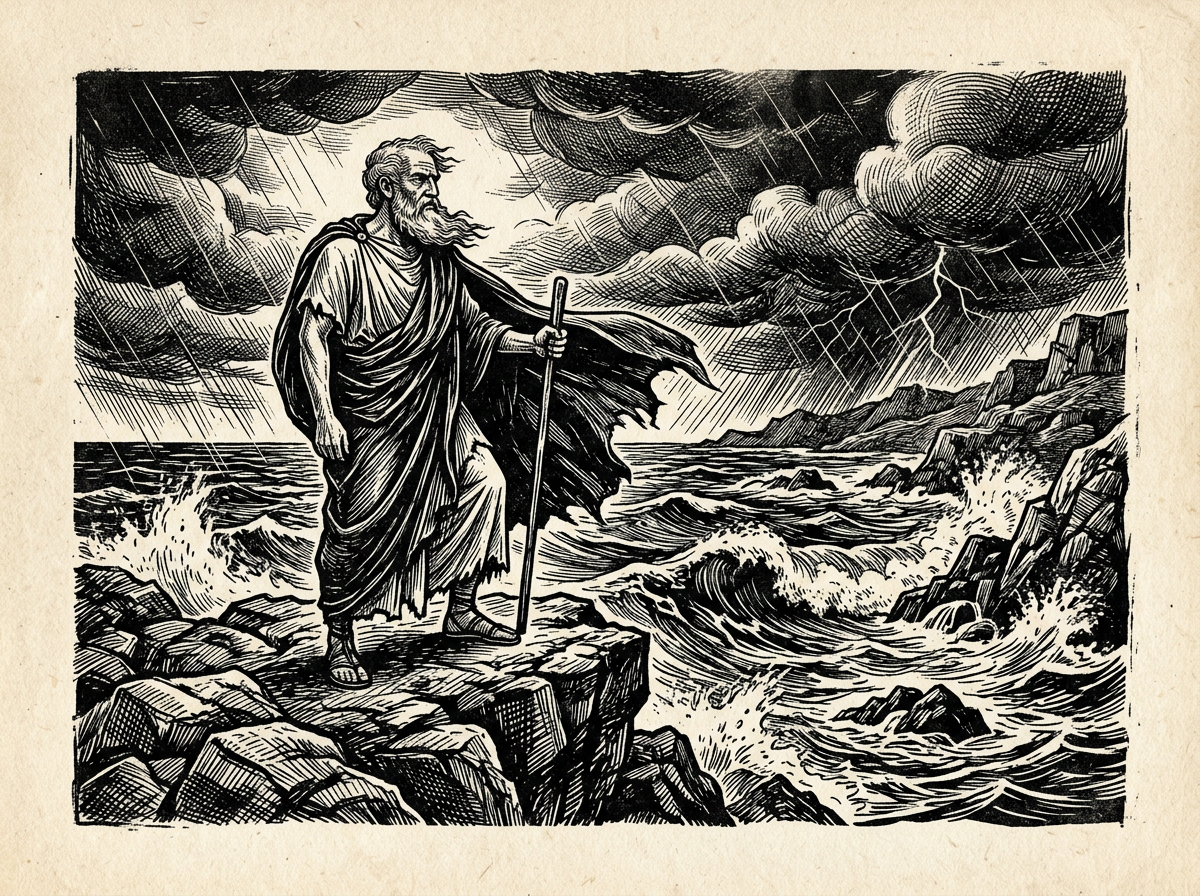
Seneca penned these words from a sun-baked, wind-scoured rock on the island of Corsica, stripped of his vast wealth, his Roman citizenship, and his family. Exiled by the emperor Claudius on trumped-up charges of adultery, he lived among hostile locals under the constant dread of an imperial assassin arriving on the next boat. He was writing to his grieving mother, Helvia, not to offer trendy mindfulness tips, but to keep her from collapsing under the social disgrace and agony of his sudden political destruction.
In the authentic text, Seneca describes Fortune not as an inconvenient nuisance, but as an invading enemy army launching a lethal assault. The preparation he commands (praemeditatio malorum) is a brutal military drill for the soul, demanding that you stand permanently in battle formation against poverty, disgrace, torture, and violent bereavement. Enduring the blow is not about shrugging off broken household items; it is about standing unshakeable when political tyranny strips you of everything you love.
THE OPENING COUNTER-PUNCH
The commentary guts an agonizing survival manual written from political exile and degrades it into middle-class kitchen maintenance. It hijacks Seneca’s battlefield defense against imperial violence and twists it into a cozy parable about chipped ceramics and winter snowfall. A desperate fight against mortal despair is sanitized into a lifestyle guide for managing domestic inconvenience.
THE BREAKDOWN
- The Domesticating Trivialization — The commentary sidesteps catastrophic political ruin to tell a fable where “The master would repeat to himself, ‘The glass is already broken.’” Seneca was consoling a mother whose son had been banished to an island penal colony, not teaching a hobbyist how to handle dropped china. Swapping the real horrors of imperial persecution for an endearing Zen story about broken crockery completely changes Seneca’s visceral military drill into gentle, unauthentic lifestyle minimalism.
- The Consumerist Downscaling of Attachment — The modern writer butchers Epictetus’s encounter with a thief, claiming he bought a cheaper lamp “so he could be less attached to it if it were stolen again.” Epictetus did not downgrade to an iron lamp to engage in budget-friendly risk mitigation, but to prove that material possessions do not belong to the soul and that the thief suffered the only real injury by corrupting his own character. Framing the incident as a consumer tactic to soften emotional pain alters a radical lesson on moral integrity into mundane asset management.
- The Sanitization of Catastrophe into Weather — The commentary finishes by trivializing existential terror into seasonal climate patterns: “No one is wrecked by the fact that it’s snowing in the winter, because we’ve accepted (and even anticipated) this turn of events.” Seneca never compared the crushing hammer of Fortune to predictable flurries outside the window; he compared it to a merciless military ambush designed to break your spirit. Reducing the catastrophic shocks of life to the mild predictability of winter weather completely obscures the jagged, terrifying reality that ancient Stoics trained themselves to endure.
What is the lesson we can learn from "Standard Academic Translation"? And how can we apply or practice it?
The lesson from the standard translation is that peace of mind requires maintaining a permanent, disciplined battle formation against sudden ruin. You cannot afford to cruise through life expecting Fortune to smile on your plans; if you treat health, social standing, and material stability as permanent entitlements, their sudden loss will leave your soul completely shattered.
To practice this, pick the pillar of your life you take most for granted your professional reputation, your life savings, or your physical mobility and stage a deliberate, unsparing mental confrontation with its total annihilation today. Refuse the comfort of viewing this loss as a remote, abstract possibility. See yourself stripped bare, standing directly in the wreckage without panic, and drill your mind to remember that your moral integrity is the only weapon Fortune cannot confiscate.
HOW THE PHILOSOPHER WOULD RESPOND
Seneca would look with icy disdain upon anyone using his words to soothe the mild annoyance of broken glassware, reminding the reader that philosophy exists to prepare a person for execution, poverty, and exile.
“Misfortune falls heavily on those to whom she is new; the man who is always expecting her easily beats her back. For the arrival of that which has been long foreseen comes gentle. Do you want to know what makes this blow so heavy? It is that you thought yourself exempt from the laws that govern humanity.” - Seneca, On Consolation to Helvia, 5.3
4
Chaff & Wheat Analysis
The Chaff: Popular commentators routinely oversimplify Stoic premeditation into a toothless lifestyle hack for managing domestic friction and softening material attachment. This trivializes life's true tragedies, pretending ancient survival manuals were written to soothe comfortable modern consumers.
The Wheat: Authentic resilience requires deliberately contemplating the sudden, total collapse of your most cherished worldly pillars—such as health, freedom, or livelihood. By accepting that catastrophic ruin can strike at any moment, you anchor your stability solely in the moral integrity no tyrant or misfortune can confiscate.
Related dispatches
FALSE COMFORT: SANITIZED MORTALITY · A Critique of Modern Stoicism
Modern Stoicism sanitizes ancient dread into comfortable lifestyle poetry
24 Nov 2026
FATAL COMPROMISE: COMMODIFIED RESILIENCE · A Critique of Modern Stoicism
Epictetus did not teach resilience to protect your quiet morning routine
24 Nov 2026
CORE FALLACY: NOSTALGIC VIRTUE · A Critique of Modern Stoicism
True virtue is an immediate choice, not a nostalgic peak experience
22 Nov 2026
MODERN RESTRAINT: CURBED ENTITLEMENT · The Bend Index
Moderation is not puritanism: finding humility in an age of impulse
25 Nov 2026