FATAL FLAW: SOLIPSISTIC COMFORT
19 Nov 2026
Stoic surrender is not a mindfulness lullaby for fragile modern egos
19th November: Maxims From Three Wise Men | Pandering Secular Comfort from an Oath of Total Surrender
THE DUAL-TRANSLATION HEADER
The Text in Question
The Daily Stoic Rendering
“For any challenge we should hold three thoughts at our command: ‘Lead on God and Destiny, To that Goal fixed for me long ago. I will follow and not stumble; even if my will is weak I will soldier on.’” - Cleanthes
“Whoever embraces necessity count as wise, skilled in divine matters.” - Euripides
“If it pleases the gods, so be it. They may well kill me, but they can’t hurt me.” - Plato’s Crito and Apology - Epictetus, Enchiridion, 53
Standard Academic Translation
“On every occasion we should have these thoughts ready at hand: ‘Lead me, O Zeus, and thou, O Destiny, whithersoever I have been appointed by you to go; for I will follow without hesitation; and even if I refuse, having become base, I must follow nonetheless.’ (Cleanthes)
‘Whosoever has yielded well to necessity we consider wise among us, and acquainted with divine things.’ (Euripides)
‘Well, Crito, if this is pleasing to the gods, so let it be.’ (Plato, Crito)
‘Anytus and Meletus can kill me, but they cannot hurt me.’ (Plato, Apology)”
- Enchiridion 53 (trans. Robin Hard)
ACADEMIC CONTEXT & BREAKDOWN
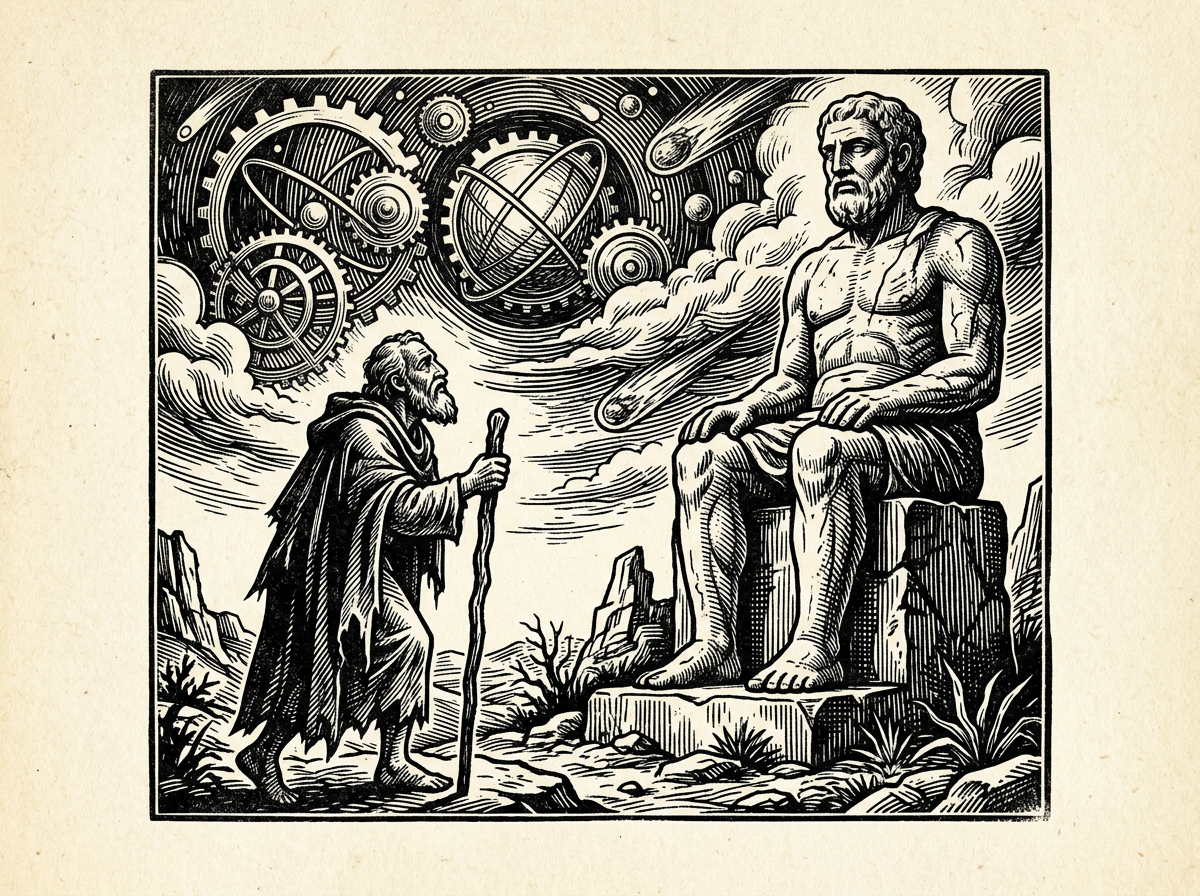
Epictetus taught in a drafty, bare lecture room in Nicopolis, an exiled former slave with a shattered, lame leg leaning on a rough wooden staff. He looked into the eyes of young students living under the shadow of Domitian’s terror, knowing that a single unmeasured word could mean imperial arrest, confiscation of goods, or the executioner's blade. These four maxims were not collected as bedtime affirmations, but as an emergency arsenal of war for the soul facing absolute ruin.
In Hard’s academic translation, the tone is uncompromising submission and mortal defiance. Cleanthes does not boast about "soldiering on"; he acknowledges an iron law of deterministic physics: if you follow divine destiny willingly, you remain noble, but if you rebel out of cowardice, destiny drags you forward regardless. Coupled with Socrates standing before an Athenian jury that is about to condemn him to drink hemlock, these lines declare that external destruction cannot breach the moral citadel of the soul unless you surrender your virtue to fear.
THE OPENING COUNTER-PUNCH
The commentary guts an existential battle oath and degrades it into an agnostic mindfulness lullaby. It hijacks a slave’s emergency defenses against state execution and twists them into a cozy mental game to help consumers feel emotionally coddled. A ruthless surrender to cosmic determinism is sanitized into a patronizing fantasy that the universe is curating custom experiences just for you.
THE BREAKDOWN
- The Inversion of Inevitability into Heroic Agency — The commentary relies on a mangled translation of Cleanthes that pledges, “even if my will is weak I will soldier on.” The authentic Greek text contains no self-help pep talk about summoning grit; it bluntly states that if you become bad and refuse, “I must follow nonetheless.” Transforming Cleanthes's grim leash where fate drags the howling dog that refuses to run alongside the cart into modern grit culture completely changes an unyielding physical reality into a flattering ego trip.
- The Secularization of Cosmic Law into Disney Solace — The modern writer trivializes the providential Logos by advising the reader that “you can take some comfort in the various laws of the universe or even the circle of life.” Epictetus did not cite Euripides and Cleanthes so readers could hum catchy tunes about the "circle of life" to soothe mild annoyances; he invoked the divine, causal necessity of the cosmos to remind you that your personal comfort is entirely subservient to the whole. Replacing severe cosmic piety with generic secular "comfort" fundamentally distorts Stoic physics into empty sentimentalism.
- The Solipsistic Fabrication of a Personal Universe — The commentary urges the reader to “Pretend that each event, whether desired or unexpected, was willed to happen, willed specifically for you.” This is a complete inversion of ancient Stoic doctrine, which repeatedly insists that universal nature acts for the cosmos as a whole, not to pamper your fragile vanity. Telling an anxious modern reader to play pretend that the cosmos is an all-inclusive concierge catering “specifically for you” fuels the very self-absorption that Stoicism was designed to eradicate.
What is the lesson we can learn from "Standard Academic Translation"? And how can we apply or practice it?
The lesson from the standard translation is that necessity is completely indifferent to your preferences, and fighting it only transforms necessary suffering into moral disgrace. The cosmos moves according to universal law; you can either walk alongside it with dignity, or kick, scream, and be dragged through the mud anyway while your virtue collapses.
To practice this, take an outcome today that has gone disastrously wrong an unfair financial penalty, a betrayal, or a broken plan and cease all internal negotiations. Refuse to soothe your ego by pretending the universe designed this to teach you a special personal lesson. Acknowledge that the circumstance has arrived by unyielding necessity, whisper Socrates’s words that external hands can ruin your circumstances but cannot corrupt your character, and fulfill your duty without whining.
HOW THE PHILOSOPHER WOULD RESPOND
Epictetus would scoff at the idea that his emergency maxims should be softened into a make-believe exercise for fragile egos, reminding the reader that philosophy trains a man to face the tyrant’s blade, not to daydream about a cozy universe.
“For what is a tyrant? The body, and its possessions, and your local magistrates, and your taxes. Then let them take them all, strip yourself of them! ‘Lead me, O Zeus, and thou, O Destiny!’ Do you see how he speaks to the gods? He does not say, ‘Deliver me from this,’ or ‘Why have you done this to me?’ but ‘Lead me whithersoever it pleases you.’” - Epictetus, Discourses, 4.1.131, 4.4.34
Chaff & Wheat Analysis
The Chaff: The article challenges the comforting myth that Stoicism means treating every setback as a personalized gift from the universe. Its own rhetoric risks another oversimplification: that distress or resistance to injustice necessarily represents moral failure.
The Wheat: The durable insight is to acknowledge what has happened without assuming it serves your personal growth, then direct your effort toward judgments and actions you can influence. This does not require belief in cosmic determinism, emotional numbness, or surrendering opportunities to challenge an unfair outcome.
Related dispatches
FALSE COMFORT: SANITIZED MORTALITY · A Critique of Modern Stoicism
Modern Stoicism sanitizes ancient dread into comfortable lifestyle poetry
24 Nov 2026
FATAL COMPROMISE: COMMODIFIED RESILIENCE · A Critique of Modern Stoicism
Epictetus did not teach resilience to protect your quiet morning routine
24 Nov 2026
MODERN STOICISM: TRIVIALIZED CATASTROPHE · A Critique of Modern Stoicism
Ancient Stoicism was forged for catastrophe, not broken kitchenware
22 Nov 2026
MODERN RESTRAINT: CURBED ENTITLEMENT · The Bend Index
Moderation is not puritanism: finding humility in an age of impulse
25 Nov 2026