TEXTUAL DISTORTION: TACTICAL DISCRETION
17 Nov 2026
Why self-help mistakes Seneca's survival tactics for modern tolerance
17th November: Judge Not, Lest . . . | Smuggling Postmodern Relativism into a Warning Against Provoking Tyrants
THE DUAL-TRANSLATION HEADER
The Text in Question
The Daily Stoic Rendering
“When philosophy is wielded with arrogance and stubbornly, it is the cause for the ruin of many. Let philosophy scrape off your own faults, rather than be a way to rail against the faults of others.” - Seneca, Moral Letters, 103.4b-5a
Standard Academic Translation
“Philosophy has been the ruin of many, when practiced with arrogance and obstinacy. Let it scrape off your own defects, not reproach those of others. Let it not withdraw itself from the customs of humankind, nor make it seem that it condemns all that it does not do itself. A person can practice wisdom without parade, and without arousing jealousy.” - Letters on Ethics to Lucilius, 103.4b-5a (trans. Margaret Graver and A. A. Long)
ACADEMIC CONTEXT & BREAKDOWN
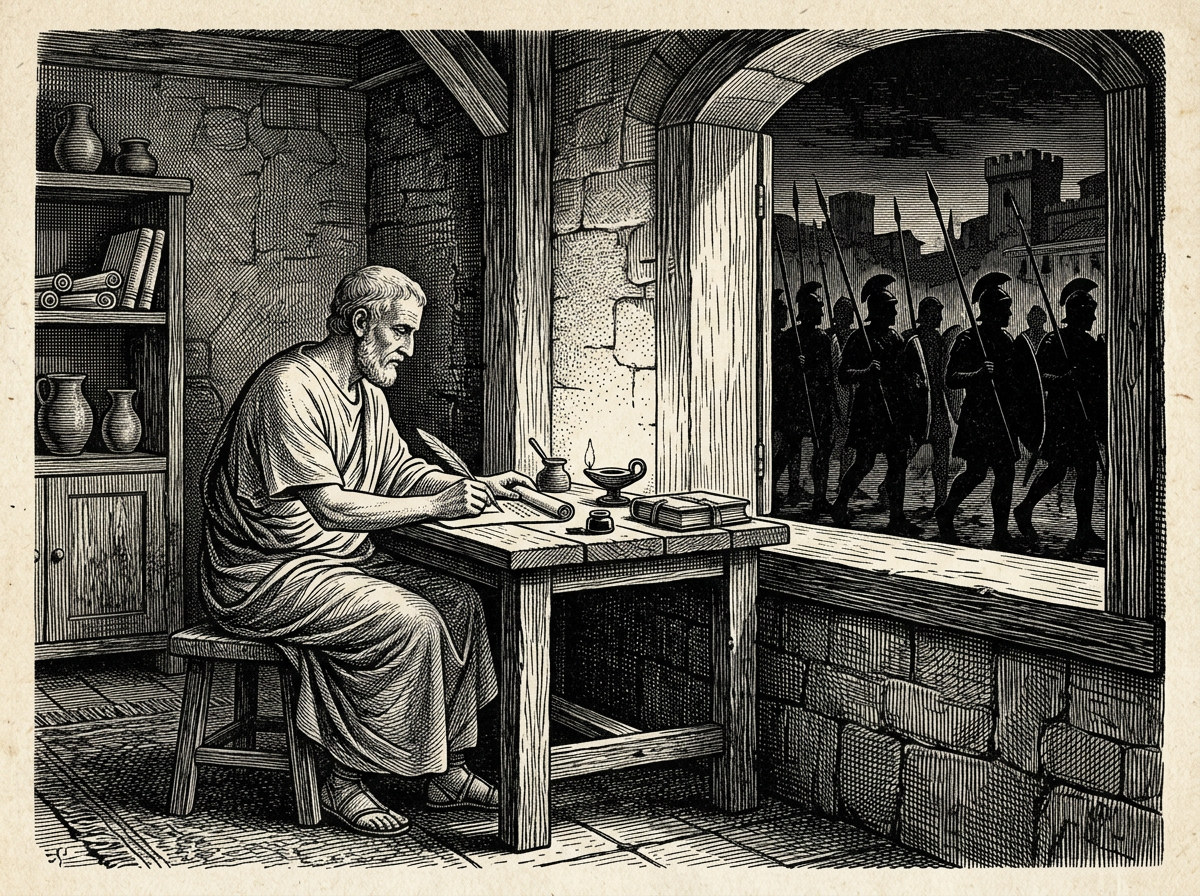
Seneca dictated these words in the final, suffocating years of his life, exiled within his own home while Nero’s Praetorian guards and paranoid informants circled ever closer. He had watched fellow senators and high-minded Stoic martyrs, men who ostentatiously flaunted their moral superiority and publicly mocked the court’s vices dragged to the executioner's block or forced to bleed out in warm baths.
In the authentic translation, Seneca is not providing a lecture on etiquette or tolerant open-mindedness; he is dispensing survival tactics for walking through a den of deadly beasts. Ostentatious, aggressive philosophy (arrogantia et contumacia) invites political execution, not because the vices of tyrants are off-limits to objective moral judgment, but because taunting armed madmen is suicidal vanity. True wisdom cleanses the practitioner's flaws in private, adopting an unassuming exterior to practice virtue without inviting fatal retribution.
THE OPENING COUNTER-PUNCH
The commentary guts Seneca’s grim survival manual under imperial tyranny and degrades it into postmodern non-judgmentalism. It hijacks a life-or-death warning against baiting executioners and twists it into a feel-good sermon on minding your own business and celebrating everyone's personal journey. Political discretion in the face of lethal power is sanitized into a cheap cliché of modern social tolerance.
THE BREAKDOWN
- The Relativistic Individualization of Virtue — The commentary betrays Seneca's objective moral framework by claiming that philosophy means leaving others “to that task for themselves and their own journey.” Seneca never viewed virtue as a subjective "journey" where everyone invents their own ethics; he regarded moral vice as an objective illness and moral duty as a cosmic obligation to human fellowship. Swapping cosmic moral realism for therapeutic self-absorption changes Seneca’s pragmatic caution into hollow moral relativism.
- The Prohibition Fallacy Against Moral Judgment — The modern writer invents a rule of absolute neutrality by asserting that “nothing in Stoic philosophy empowers you to judge them, only to accept them.” Seneca explicitly held that reason must judge evil as evil, vice as vice, and corrupt tyrants as corrupt tyrants; what he forbade was the suicidal display of public condemnation that invites your own destruction. Conflating tactical silence with the intellectual refusal to judge moral corruption distorts Stoic discernment into spineless complacency.
- The Inversion of Political Self-Defense — The commentary treats moral restraint as a gentle lifestyle choice, cooing that we should let others be “especially when we have so many of our own.” Seneca’s actual text warns that philosophy has been “the ruin of many” because it “aroused jealousy” and provoked sovereign wrath. Erasing the imperial crosshairs from the text completely conceals Seneca’s true lesson: self-effacement is not a plea for mutual non-judgment, but a shield against the blades of powerful enemies.
What is the lesson we can learn from "Standard Academic Translation"? And how can we apply or practice it?
The lesson from the standard translation is that virtue must never be flaunted as a weapon of moral vanity or used to pick needless fights. Parading your principles, publicly shaming the unprincipled, or deliberately alienating the culture around you does not prove moral strength; it displays childish arrogance that invites hostility and destroys your ability to do good.
To practice this, take an environment where you are surrounded by behaviors or standards you find corrupt whether a toxic corporate workplace, an unethical industry, or an adversarial social circle and abandon all desire to lecture, scold, or signal moral superiority. Eradicate your own vanity in private, fulfill your duties with quiet precision, and fit into the harmless customs of the group so you can preserve your integrity without painting a target on your back.
HOW THE PHILOSOPHER WOULD RESPOND
Seneca would scorn the idea that his hard-won survival tactics should be reduced to modern slogans about non-judgmental acceptance, reminding the reader that philosophy avoids ostentation to safeguard the soul, not to play the passive bystander to madness.
“The wise person will never stir up the anger of the powerful; he will avoid it, just as a sailor avoids a storm... Philosophy promises this above all: a sense of common humanity, of fellowship, of community. But our arrogant separation from everyday customs will divide us from that very thing. Let our aim be to live a better life than the crowd, not a contrary one.” - Seneca, Letters on Ethics to Lucilius, 14.7, 5.2
3
Chaff & Wheat Analysis
The Chaff: The article challenges the self-help myth that Stoic restraint means never judging others’ conduct: avoiding self-righteous confrontation is not the same as accepting wrongdoing. Its own framing risks overcorrection by treating political survival as the passage’s sole lesson and modern tolerance as necessarily relativistic.
The Wheat: Use philosophy first to correct your own conduct, not to advertise moral superiority, while retaining the ability to recognize harm. Where power makes confrontation dangerous, choose proportionate, effective ways to uphold your principles; discretion need not mean complicity, and speaking up need not mean vanity.
Related dispatches
FALSE COMFORT: SANITIZED MORTALITY · A Critique of Modern Stoicism
Modern Stoicism sanitizes ancient dread into comfortable lifestyle poetry
24 Nov 2026
FATAL COMPROMISE: COMMODIFIED RESILIENCE · A Critique of Modern Stoicism
Epictetus did not teach resilience to protect your quiet morning routine
24 Nov 2026
MODERN STOICISM: TRIVIALIZED CATASTROPHE · A Critique of Modern Stoicism
Ancient Stoicism was forged for catastrophe, not broken kitchenware
22 Nov 2026
MODERN RESTRAINT: CURBED ENTITLEMENT · The Bend Index
Moderation is not puritanism: finding humility in an age of impulse
25 Nov 2026