CHIEF DISTORTION: TRIVIALIZING OBLIVION
15 Nov 2026
Stoic cosmic terror was meant to crush ego, not comfort it
15th November: Everything Is Change | Transforming Cosmic Annihilation into a Mindfulness Slogan
THE DUAL-TRANSLATION HEADER
The Text in Question
The Daily Stoic Rendering
“Meditate often on the swiftness with which all that exists and is coming into being is swept by us and carried away. For substance is like a river’s unending flow, its activities continually changing and causes infinitely shifting so that almost nothing at all stands still.” - Marcus Aurelius, Meditations, 5.23
Standard Academic Translation
“Keep in mind how fast things pass by and are gone those that are now, and those to come. Existence is like a river in ceaseless flow, its actions continually changing, its causes subject to countless variations, with almost nothing standing still, and even what is near at hand hovering on the brink of an infinite abyss of the past and the future, in which all things vanish. How foolish, then, for anyone in these circumstances to puff himself up with pride, or fret, or complain, as if any of this could cause him trouble for any length of time!” - Meditations, 5.23 (trans. Robin Hard)
ACADEMIC CONTEXT & BREAKDOWN
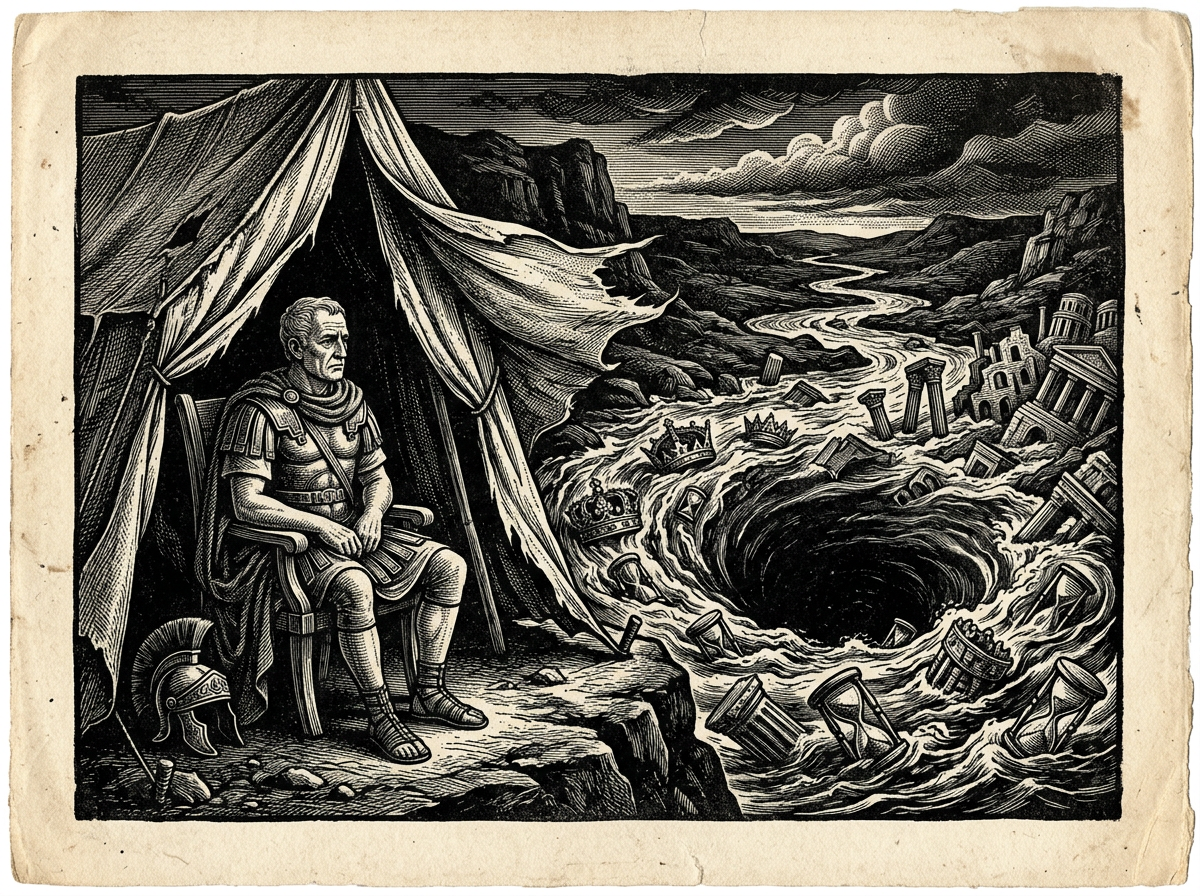
Marcus Aurelius penned these lines late at night in a freezing field headquarters along the Danubian marshes, shivering under rough wool while his lungs burned with chronic illness. Outside his tent lay thousands of his own soldiers rotting from the Antonine plague, their bodies tossed into common pits while Germanic warbands pressed against the crumbling northern frontier.
In Hard’s academic translation, Marcus is not offering a soothing mindfulness poem to help readers feel centered, but staring directly into the terrifying void of cosmic annihilation. Substance is a ravenous current dumping every throne, victory, and mortal life into an "infinite abyss" where all things vanish without a trace. The lesson is ruthless ego-demolition: realizing that earthly striving is utterly infinitesimal, leaving no rational room for human arrogance, grievance, or despair.
THE OPENING COUNTER-PUNCH
The commentary guts an imperial confrontation with cosmic oblivion and degrades it into a yoga-studio bumper sticker. It amputates Marcus’s terror of the yawning abyss and replaces it with breezy lifestyle advice about going with the flow. A brutal metaphysical axe meant to chop down human vanity is sanitized into an effortless life-hack for avoiding stress.
THE BREAKDOWN
- The Truncation of the Void — The commentary cuts off the authentic text right before Marcus invokes the "infinite abyss of the past and the future, in which all things vanish," shrinking cosmic terror into the cozy cliché that “Life is in a constant state of change. And so are we.” Marcus was not pointing out that people grow and evolve; he was confronting the horrifying speed at which entire empires, loved ones, and his own name would be erased into nothingness. Whitewashing the infinite void into a harmless affirmation of human development unauthentically strips the text of its existential weight.
- The Trivialization of Moral Failure — The modern writer reduces the grave irrationality of cosmic rebellion to mere executive inefficiency, remarking that “To kick ourselves or blame others is grabbing at the wind.” Marcus did not view anger or pride as merely a waste of time like chasing a breeze, but as an insane act of pride asking why a person would "puff himself up with pride, or fret, or complain" when their life is a microscopic speck in an infinite torrent. Changing a devastating moral critique of arrogance into a practical tip against self-blame turns sacred humility into cheap behavioral coaching.
- The New-Age Dilution of Necessity — The commentary wraps up its entry with the shallow wellness command: “Everything is change. Embrace that. Flow with it.” Marcus never told himself to "flow with it" like a modern surfer paddling along with shifting workplace trends; he commanded his soul to bow before the merciless laws of cosmic transformation (metabolē). Swapping severe fatalistic submission for the sunny instruction to "embrace" the ride corrupts Stoic physical determinism into consumerist positive thinking.
What is the lesson we can learn from "Standard Academic Translation"? And how can we apply or practice it?
The lesson from the standard translation is that every ambition, slight, and material attachment you obsess over is already hovering on the brink of complete annihilation. Striving to protect a fragile reputation or losing sleep over personal setbacks is sheer madness, because the infinite abyss of time will swallow you and your problems in an instant.
To practice this, take your most pressing anxiety a stalled career milestone, a bitter personal dispute, or financial insecurity and cast it into Marcus’s infinite river. Picture every generation before you that fretted over these identical, petty stakes, and watch them dissolve into the dark gulf of history where no one remembers their names. Use the cold reality of universal decay to kill your self-importance instantly, directing your fleeting breath solely toward acting with justice and honor right now.
HOW THE PHILOSOPHER WOULD RESPOND
Marcus Aurelius would scathingly dismiss this breezy call to "flow with it," reminding the modern reader that the cosmos does not invite us to a fun dance of change, but sweeps us relentlessly toward death.
“Despise not death, but welcome it, for nature wills it like all else. For as it is to be young and to grow old, to flourish and to reach maturity, to turn gray and to bring forth children... such also is your very dissolution. A thoughtful man should therefore not approach death with defiance or impatience, but wait for it as one of the natural operations of things.” - Marcus Aurelius, Meditations, 9.3
Chaff & Wheat Analysis
The Chaff: The article challenges the self-help myth that Stoic impermanence simply means relaxing and ‘going with the flow’: the fuller passage also challenges pride and grievance. But its insistence on cosmic terror risks another oversimplification—humility need not require self-contempt, and temporary problems can still deserve serious attention.
The Wheat: Remembering how quickly life passes can loosen attachment to status and resentment, provided it sharpens rather than replaces responsible action. The durable practice is to distinguish what you cannot preserve or control from the judgments and just actions available to you now.
Related dispatches
FALSE COMFORT: SANITIZED MORTALITY · A Critique of Modern Stoicism
Modern Stoicism sanitizes ancient dread into comfortable lifestyle poetry
24 Nov 2026
FATAL COMPROMISE: COMMODIFIED RESILIENCE · A Critique of Modern Stoicism
Epictetus did not teach resilience to protect your quiet morning routine
24 Nov 2026
MODERN STOICISM: TRIVIALIZED CATASTROPHE · A Critique of Modern Stoicism
Ancient Stoicism was forged for catastrophe, not broken kitchenware
22 Nov 2026
MODERN RESTRAINT: CURBED ENTITLEMENT · The Bend Index
Moderation is not puritanism: finding humility in an age of impulse
25 Nov 2026