FALSE ASSUMPTION: INNATE GOODNESS
31 Oct 2026
Stoicism demands grueling moral labor, not gentle affirmations of innate goodness.
31st October: You Were Born Good | The Softening of Hard Moral Discipline into Naive Romantic Utopianism
The Text in Question
The Daily Stoic Rendering
“The human being is born with an inclination toward virtue.”
- Musonius Rufus, Lectures, 2.7.1-2
Standard Academic Translation
“To begin with, mankind has been created with an inclination toward virtue... Nature has so constructed us that all of us have the capacity to live without falling into error and with nobility, not that one person can and another cannot, but all alike.”
- Musonius Rufus, Lectures, 2.1-2 (Lutz adapted)
Academic Context & Breakdown
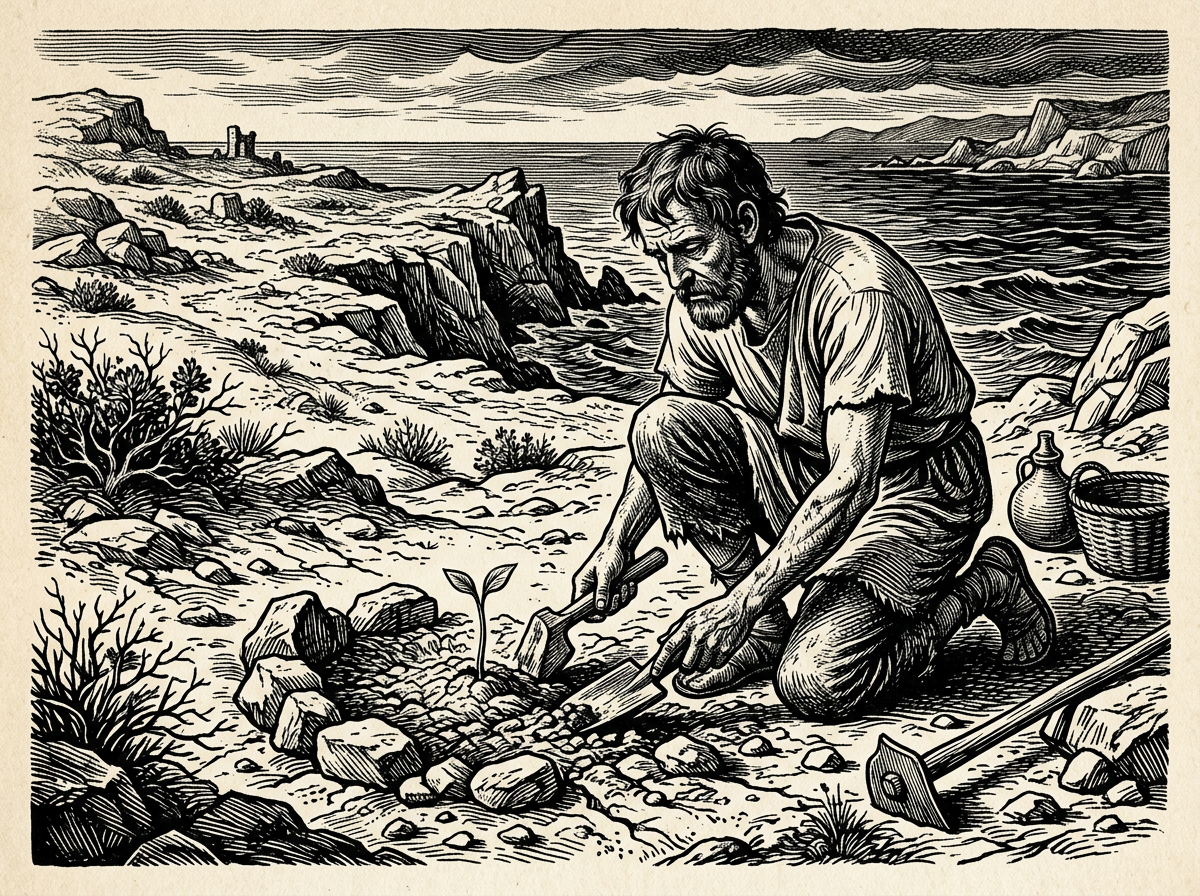
Musonius Rufus often called the "Roman Socrates" delivered these lectures in exile on the desolate, sun-baked island of Gyaros, having been banished by Emperor Nero. He was addressing students who faced state execution, land seizure, and absolute political tyranny if they dared to speak the truth.
He was not painting a rosy, romantic picture of effortless human innocence to make his audience feel good about themselves. Musonius was establishing a radical, egalitarian baseline for ethical labor: because Nature gave every human being the raw seeds (aphormai) for virtue, no person, whether slave, emperor, man, or woman, has an excuse to evade the grueling, lifelong training required to realize that moral potential.
The Opening Counter-Punch
The commentary hijacks Musonius's austere demand for universal moral labor and degrades it into a cozy, self-soothing affirmation of innate perfection. It takes a severe Stoic insistence on human capacity and twists it into a romantic, lazy excuse that blames external society for all personal vice. By swapping hard ethical cultivation for a comfortable, Rousseauian myth of pristine childhood innocence, the text sanitizes a demanding call to arms into a cheap ego-boost.
The Breakdown
- The commentary projects a soft, romantic myth onto the human spirit, declaring that "you were born good." Musonius argued that human beings are born with an inclination or capacity toward virtue, not an already fully-formed moral goodness; the commentary replaces the necessity of arduous ethical cultivation with a lazy, self-congratulatory assumption of innate purity.
- The text trivializes the immense rigor of Stoic training, claiming that "there is hardly an idea in Stoic philosophy that wouldn’t be immediately agreeable to a child or that doesn’t jibe with common sense." Musonius taught that reaching virtue requires constant, ascetic discipline to overcome entrenched irrational habits, but the commentary flattens this brutal spiritual combat into a set of obvious, low-stakes nursery rhymes.
- The commentary absolves the individual of moral agency by claiming that straying from virtue comes from "a nurturing of the wrong things and the wrong ideas." Musonius held every rational individual strictly accountable for their own choices and errors, whereas the commentary shifts the blame outward onto societal conditioning to keep the reader's self-esteem intact.
What Is the Lesson?
The authentic lesson of Musonius Rufus's second lecture is that every human being possesses the biological capacity for virtue, leaving you with zero excuses for moral failure. You practice this by treating your rational potential not as an innate trophy to celebrate, but as a seed that demands continuous, daily ethical labor to cultivate. Take total responsibility for your moral development, regardless of your background or environment.
How The Philosopher Would Respond
Musonius Rufus would flatly reject the idea that human beings are "born good" without hard work, viewing any attempt to frame virtue as easy or automatic as a dangerous, lazy delusion.
"Virtue is not a mere theoretical knowledge, but a practical skill... Just as there is no use in medical theory unless it leads to the health of the human body, so there is no value in the doctrines of philosophy unless they conduct to virtue of soul."
- Musonius Rufus, Lectures, 5.1-3
Chaff & Wheat Analysis
The Chaff: The article challenges the comforting equation of being born with a capacity for virtue with being already morally good: good intentions and affirmations cannot substitute for ethical practice. Its own insistence on “zero excuses,” however, risks treating unequal circumstances and capacities as irrelevant to moral development.
The Wheat: Moral potential is a starting point, not an achievement; it develops through repeated choices, honest self-examination, and correction of harmful habits. Take responsibility for the judgments and actions available to you without assuming that hardship itself produces virtue or that everyone faces the same constraints.
Related dispatches
FALSE COMFORT: SANITIZED MORTALITY · A Critique of Modern Stoicism
Modern Stoicism sanitizes ancient dread into comfortable lifestyle poetry
24 Nov 2026
FATAL COMPROMISE: COMMODIFIED RESILIENCE · A Critique of Modern Stoicism
Epictetus did not teach resilience to protect your quiet morning routine
24 Nov 2026
MODERN STOICISM: TRIVIALIZED CATASTROPHE · A Critique of Modern Stoicism
Ancient Stoicism was forged for catastrophe, not broken kitchenware
22 Nov 2026
MODERN RESTRAINT: CURBED ENTITLEMENT · The Bend Index
Moderation is not puritanism: finding humility in an age of impulse
25 Nov 2026