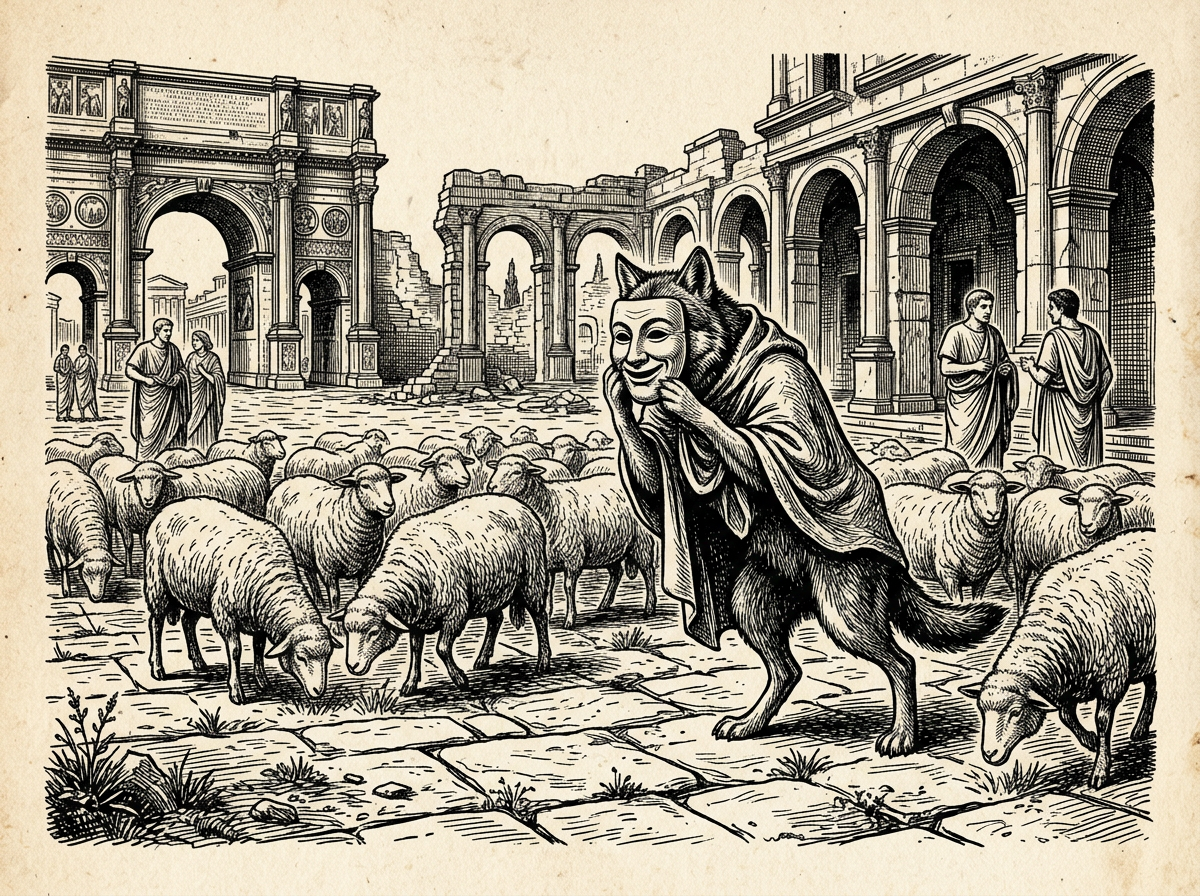
ETHICAL DILUTION: PERFORMATIVE GOODWILL
16 Oct 2026
Modern self-help reduces severe moral warnings to relatable social quirks.
18th October: Frenemies | The Domestication of Moral Treason into Relatable Social Foibles
The Text in Question
The Daily Stoic Rendering
“There’s nothing worse than a wolf befriending sheep. Avoid false friendship at all costs. If you are good, straightforward, and well meaning it should show in your eyes and not escape notice.”
- Marcus Aurelius, Meditations, 11.15
Standard Academic Translation
“There is nothing more shameful than a wolf’s friendship [with a sheep]. Avoid false friendship above all things. The good, simple, and kindly man has it in his eyes, and it cannot be hidden.”
- Marcus Aurelius, Meditations, 11.15 (Farquharson adapted)
Academic Context & Breakdown
Marcus Aurelius penned this warning in his imperial tent along the Danube, surrounded by flatterers, political opportunists, and senators secretly plotting his overthrow. He knew that in the court of Rome, a treacherous "friend" was far more lethal than an enemy's army.
The original passage is a fierce, uncompromising demand to eradicate moral duplicity from human nature. Marcus compares a treacherous ally to a predator wearing a disguise, insisting that true character must radiate naturally from a man's very soul without any calculated performance.
The Opening Counter-Punch
The commentary hijacks Marcus’s sharp warning against moral treason and degrades it into a gentle session of self-help therapy. It takes a severe command to purge duplicity from your spirit and twists it into a cozy reassurance that everyone engages in a little casual backstabbing. By normalizing betrayal as a universal quirk, the text sanitizes Marcus’s fierce call for integrity to sell a comfortable, low-stakes absolution.
The Breakdown
- The commentary takes Marcus’s severe warning against predatory deception and dilutes it into a pop-psychology buzzword, assuring the reader that "we’ve all been a frenemy at one point or another." Marcus treated false friendship as a shameful corruption of rational nature, but the commentary rebrands treacherous behavior as a harmless, universal habit to make the reader feel better about their own flaws.
- The text trivializes genuine moral failure into petty social gossip, pointing out how "we’ve been nice to their face... but later, in different company, we said how we really felt." Marcus was condemning systemic hypocrisy and calculated deception, whereas the commentary shifts the focus to minor social politeness, reducing a serious ethical standard to a guide for office etiquette.
- The commentary nudges the reader toward self-satisfied moral passivity, concluding that this behavior is merely "worth remembering the next time we accuse someone else of being a bad friend." Marcus demanded the immediate, radical eradication of false character, but the commentary alters his command into a soft plea for mutual tolerance and non-judgmental comfort.
What Is the Lesson?
The authentic lesson of Meditations 11.15 is that false friendliness is an absolute corruption of human nature that cannot be masked by polite manners. You practice this by ruthlessly stripping away every trace of performative goodwill, social manipulation, and two-faced politeness in your daily interactions. Let your honesty be so transparent and immediate that it requires no explanation or social choreography.
How The Philosopher Would Respond
Marcus Aurelius would flatly reject the attempt to excuse hypocritical behavior as a relatable human phase, viewing any calculated dishonesty as a total betrayal of rational fellowship.
"A hypocritical friend is the worst thing imaginable; avoid it above all things. The good, straightforward, and kindly man has it in his eyes, and it does not escape notice."
- Marcus Aurelius, Meditations, 11.15
Chaff & Wheat Analysis
The Chaff: The article challenges the comforting idea that two-faced friendship is merely a relatable social quirk, and that admitting everyone does it excuses the harm. Its own account overreaches when it equates ordinary tact with betrayal or suggests integrity must be immediately visible.
The Wheat: Recognizing your own hypocrisy can support accountability rather than excuse it: the test is whether you stop misleading people and repair harm. Integrity means aligning your words and conduct without confusing honesty with indiscriminate disclosure or kindness with deception.
Related dispatches
FALSE COMFORT: SANITIZED MORTALITY · A Critique of Modern Stoicism
Modern Stoicism sanitizes ancient dread into comfortable lifestyle poetry
24 Nov 2026
FATAL COMPROMISE: COMMODIFIED RESILIENCE · A Critique of Modern Stoicism
Epictetus did not teach resilience to protect your quiet morning routine
24 Nov 2026
MODERN STOICISM: TRIVIALIZED CATASTROPHE · A Critique of Modern Stoicism
Ancient Stoicism was forged for catastrophe, not broken kitchenware
22 Nov 2026
MODERN RESTRAINT: CURBED ENTITLEMENT · The Bend Index
Moderation is not puritanism: finding humility in an age of impulse
25 Nov 2026