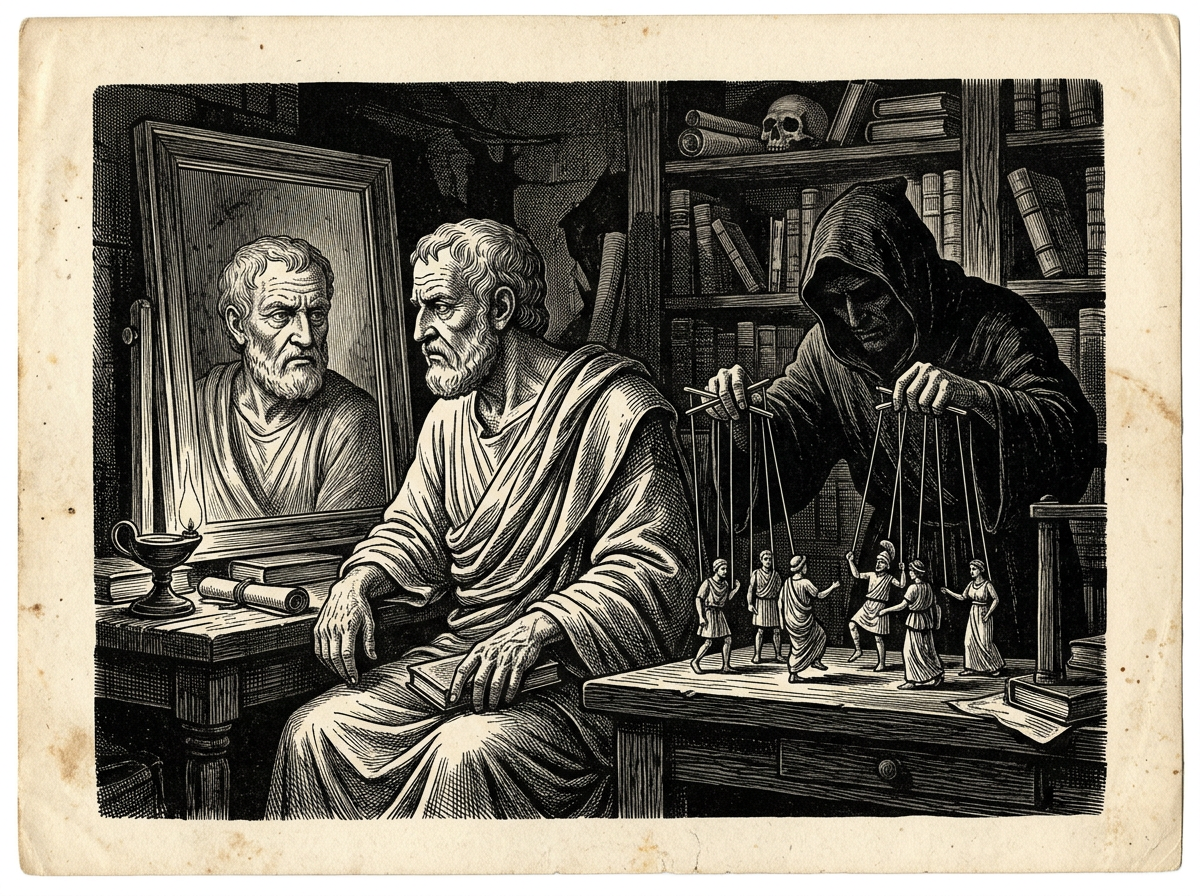
CORE ERROR: MANIPULATIVE STOICISM
23 Aug 2026
Turning Seneca's moral clarity into a dark psychology life hack
23rd August - It’s In Your Self-Interest
“Therefore, explain why a wise person shouldn’t get drunk not with words, but by the facts of its ugliness and offensiveness. It’s most easy to prove that so-called pleasures, when they go beyond proper measure, are but punishments.”
SENECA, MORAL LETTERS, 83.27
The commentary:
Is there a less effective technique to persuading people to do something than haranguing them? Is there anything that turns people off more than abstract notions? That’s why the Stoics don’t say, “Stop doing this, it’s a sin.” Instead they say,
“Don’t do this because it will make you miserable.”
They don’t say, “Pleasure isn’t pleasurable.” They say,
“Endless pleasure becomes its own form of punishment.”
Their methods of persuasion hew the line in The 48 Laws of Power:
“Appeal to People’s Self-Interest Never to Their Mercy or Gratitude.”
If you find yourself trying to persuade someone to change or do something differently, remember what an effective lever self-interest is. It’s not that this or that is bad, it’s that it is in their best interest to do it a different way. And show them don’t moralize. And what happens when you apply this way of thinking to your own behavior?
Chaff & Wheat Analyse:
takes Seneca’s call for moral clarity and twists it into a cheap, Machiavellian manual for psychological manipulation.
The Distortion of Truth
- The Trap — Seneca is warning against the physical ugliness, loss of control, and self-inflicted misery of addiction (overindulgence). The commentator transforms this moral warning into a tool for manipulating other people.
- The Sordid Lie — He cites The 48 Laws of Power a book built on deception, amoral opportunism, and exploitation and claims Stoicism follows its logic. This is a profound distortion. Stoicism calls for virtue for its own sake; The 48 Laws of Power preaches weaponized selfishness.
- The Coward’s Shift — Seneca calls for showing the objective, repulsive truth of vice ("the facts of its ugliness"). The commentator replaces truth with "levers" and "tactics." He shifts Seneca’s focus on personal virtue to a cynical obsession with managing and persuading others.
Ego Over Truth: Why the Commentator Distorts
This isn't an innocent misreading; it is a calculated marketing scheme. Real Stoicism demands self-mastery, humility, and strict moral accountability. But telling readers to scrutinize their own flaws doesn't go viral promising them hidden power over others does.
The commentator deliberately strips Stoicism of its moral weight and repackages it as a dark-psychology life hack. He flatters the reader’s ego, telling them they can bypass "moralizing" and use self-interest to control human behavior. By degrading Seneca into a Machiavellian strategist, he validates the reader's self-centered ambitions to build his own mass appeal.
How Marcus Aurelius Would Respond
Marcus Aurelius would condemn the commentary as a slimy, soul-corrupting betrayal of philosophy.
“Whenever you suffer anger or grief, remember that the life of man is a tiny point... and that all men are acting out of an impulse toward what seems good to them.”
- Meditations, 11.18
To Marcus, treating human beings like machines to be manipulated with "levers" is an insult to the rational universe (Logos). He would ruthlessly point out that worrying about how to trick others into doing your bidding while citing manuals on selfish power is the ultimate proof of a corrupt, insecure mind. Stoicism is about governing yourself, not pulling strings on others.
Chaff & Wheat Analysis
The Chaff: The article challenges the self-help myth that Stoic advice about excess is really a technique for controlling others through self-interest. Yet its rebuttal overreaches: appealing to someone’s interests is not inherently manipulation, and the quoted commentary does not establish a deliberate scheme to deceive.
The Wheat: Showing how excess undermines someone’s own well-being can make advice more persuasive when the consequences are honestly represented and their freedom to choose is respected. The durable Stoic lesson is to examine and govern your own conduct, not mistake persuasive skill for virtue or control over others.
Related dispatches
FALSE COMFORT: SANITIZED MORTALITY · A Critique of Modern Stoicism
Modern Stoicism sanitizes ancient dread into comfortable lifestyle poetry
24 Nov 2026
FATAL COMPROMISE: COMMODIFIED RESILIENCE · A Critique of Modern Stoicism
Epictetus did not teach resilience to protect your quiet morning routine
24 Nov 2026
MODERN STOICISM: TRIVIALIZED CATASTROPHE · A Critique of Modern Stoicism
Ancient Stoicism was forged for catastrophe, not broken kitchenware
22 Nov 2026
MODERN RESTRAINT: CURBED ENTITLEMENT · The Bend Index
Moderation is not puritanism: finding humility in an age of impulse
25 Nov 2026