FALSE METAPHOR: EFFORTLESS ATTRACTION
25 Nov 2026
True magnetism requires an external strike, not passive alignment
What Is a Naturally Magnetic Rock and How to Identify One
Quick Summary: What You Need to Know
A naturally magnetic rock—most commonly known as lodestone—is a piece of the mineral magnetite that has been permanently magnetized by Earth’s magnetic field, often triggered by powerful lightning strikes. These remarkable stones require zero external power sources or batteries, yet they are fully capable of attracting small iron objects like paperclips, needles, and iron shavings right out of the box.
If you have ever stumbled across a heavy, dark stone outdoors and wondered if it possesses a hidden magnetic pull, you are holding a fascinating piece of geological history. For centuries, these natural magnets served as the very first compasses, guiding ancient mariners and explorers across uncharted oceans long before the invention of modern electronics.
Background & Essential Facts
To truly understand what makes a naturally magnetic rock so special, we have to look beneath the surface at its mineral makeup. According to mineralogical data from the United States Geological Survey (USGS), lodestone is a naturally magnetized variety of magnetite ($Fe3O4$), one of the most common iron oxides on Earth.
While ordinary magnetite is strongly attracted to magnets (much like iron or steel), it does not usually act as a magnet itself. It is a passive participant. Lodestone is different. It is an active participant.
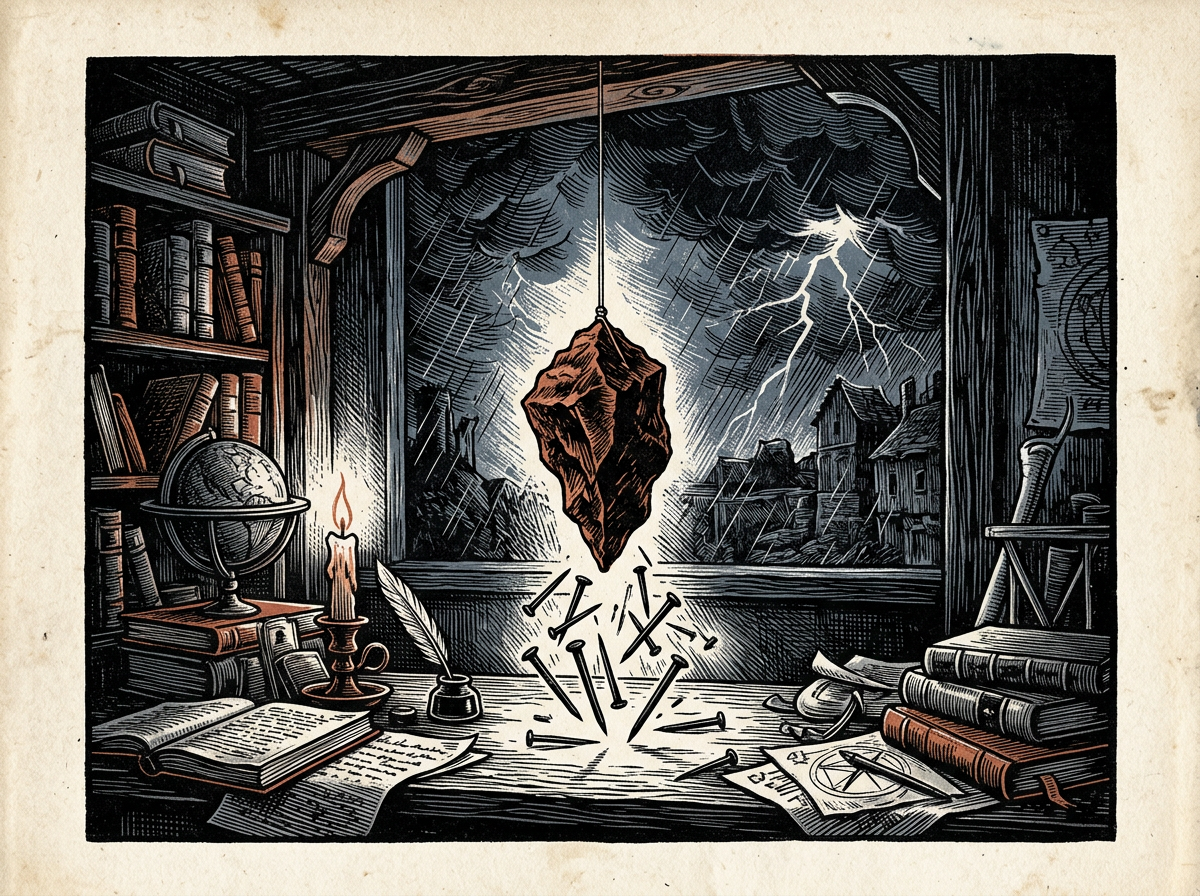
So, how does a regular rock turn into a permanent magnet? The transformation is nothing short of explosive. Geologists and physicists have discovered that most lodestones owe their magnetic powers to ancient lightning strikes. When a massive bolt of lightning arcs through the ground near a magnetite-rich deposit, it generates an immense, localized magnetic field. This sudden surge of electrical energy forces the microscopic magnetic domains inside the magnetite crystals to align in the exact same direction. Once the rock cools and the dust settles, that alignment becomes permanent. The rock has been successfully "switched on" by nature, turning an ordinary stone into a permanent natural compass.
Throughout history, these stones have captured human imagination. The ancient Greeks, Chinese, and Mayans all documented the mysterious "loving stone" that could pull iron toward itself as if by magic. In fact, the word "magnet" itself is often traced back to Magnesia, an ancient region in Greece where these remarkable stones were famously discovered in abundance.
How To Take Action / What To Do
If you suspect you have found a naturally magnetic rock in your backyard, on a hiking trail, or in a rock-hounding kit, you don't need a laboratory to test it. You can easily verify its identity using a few simple household items. Here is how to test your specimen step by step:
Step 01: Test with Iron Filings or Paperclips
The most direct way to prove your rock is naturally magnetic is to see if it can pick up small pieces of metal without any assistance. Bring your rock close to a small pile of iron shavings, steel pins, or lightweight paperclips.
Watch the reaction closely. A true lodestone will instantly draw the small metal objects toward its surface, particularly near its strongest points (the "poles" of the stone). Keep in mind that ordinary magnetite will attract a magnet, but a lodestone will actively attract unmagnetized metal. If your rock manages to pick up a paperclip entirely on its own, you are holding a natural magnet.
Step 02: Check the Mineral Composition
Not every heavy rock is a lodestone. To confirm that your specimen is indeed magnetite, you need to examine its physical characteristics. Magnetite has a very distinct look and feel.
First, check the color and luster: lodestones typically feature a dark gray to black color, often with a sub-metallic or metallic sheen. Next, check its heft. Magnetite is exceptionally dense and heavy compared to ordinary rocks of the same size. If you want to take it a step further, you can perform a classic streak test by dragging the rock across an unglazed porcelain tile. A true magnetite specimen will leave behind a distinct, dark black streak.
Step 03: Use a Compass Test
Because lodestones are naturally magnetized by the Earth, they interact directly with the planet's magnetic field. You can demonstrate this ancient navigational property at home with a simple suspension test.
Take your rock and tie a piece of non-magnetic thread securely around its center. Hang the rock freely from a pencil, stick, or your hand, making sure it is not touching any surfaces or other metals. Give it a gentle nudge and wait for it to come to a complete stop. Much like a traditional compass needle, the lodestone will slowly rotate until it aligns itself with the Earth's magnetic north and south poles. Turn the hanging mechanism around, and the rock will stubbornly swing back to point in that same directional axis.
Key Takeaways
- The Definition: — A naturally magnetic rock is typically a lodestone—a piece of magnetite permanently magnetized by intense natural forces like lightning strikes.
- Self-Powered Attraction: — Lodestones require no batteries or external power to pull small iron objects, such as paperclips and iron filings, directly to their surface.
- Easy Home Testing: — You can quickly verify a lodestone by testing its iron attraction, checking its heavy density and dark metallic luster, and watching it align with the Earth's poles when hung by a string.
Chaff & Wheat Analysis
The Chaff: Self-help lore often treats personal 'magnetism' as an innate, unforced property that manifests without friction. This overlooks the physical reality that raw material sits entirely inert until an outside shock forces its internal structure into order.
The Wheat: Durable agency is forged through severe pressure that permanently coordinates internal priorities toward a fixed pole. Once that alignment holds, one ceases to react passively to environmental currents and begins to serve as a reliable guide.
Related dispatches
MODERN RESTRAINT: CURBED ENTITLEMENT · The Bend Index
Moderation is not puritanism: finding humility in an age of impulse
25 Nov 2026
TACTICAL OVERSIGHT: POWER DYNAMICS · The Bend Index
Setting boundaries requires the leverage to survive their enforcement
25 Nov 2026
LEISURE DRIFT: PRESCRIPTIVE CONSUMPTION · The Bend Index
When mindless entertainment is repackaged as an actionable life protocol
24 Nov 2026
CRITICAL BLINDSPOT: EMERGENCY INFRASTRUCTURE · The Bend Index
Survival in catastrophe demands routing to systems, not nearby emergency rooms
24 Nov 2026