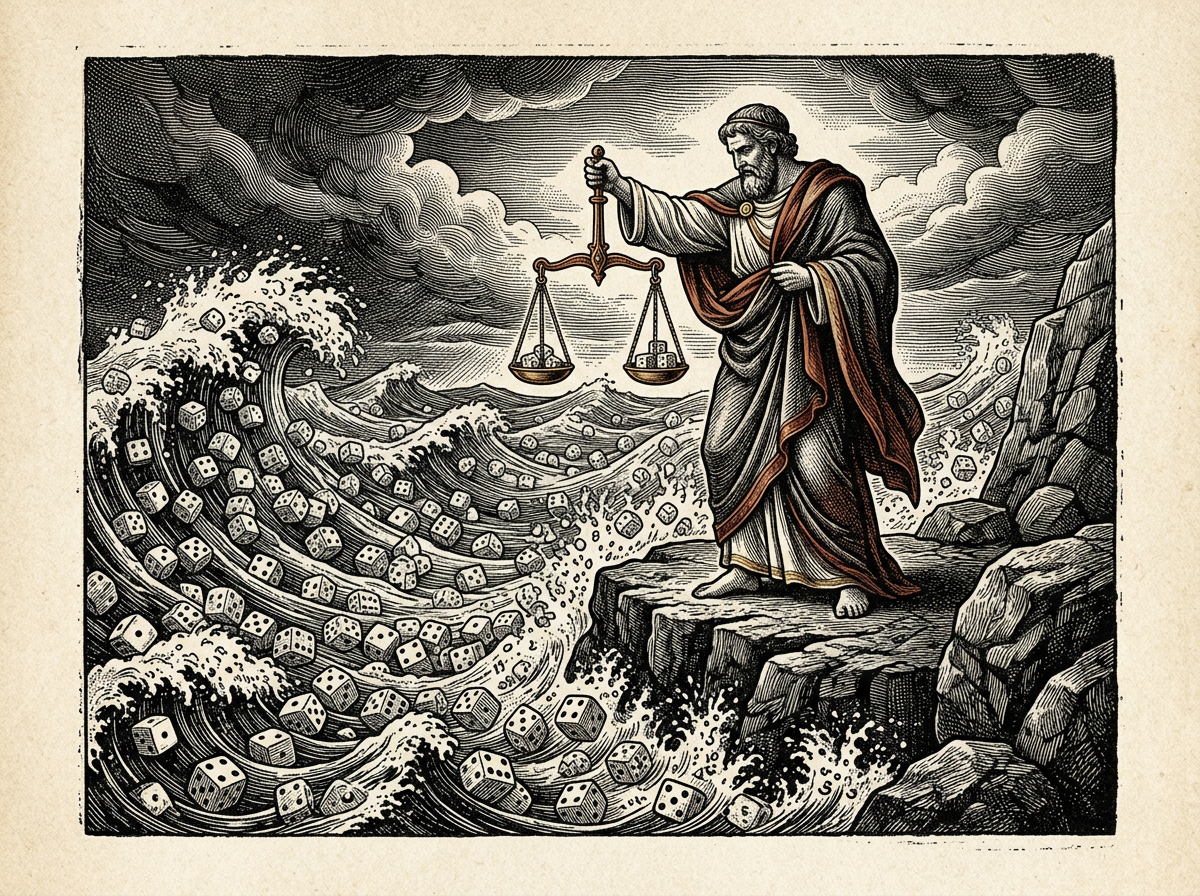
MORAL RISK: TRANSACTIONAL STOICISM
22 Nov 2026
Stoic virtue is an active duty, not a risk-free personal hedge
What Is the Philosophy of the Marcus Aurelius Wager and How Does It Apply to Modern Life?
Quick Summary: What You Need to Know
The "Marcus Aurelius Wager" is a modern philosophical thought experiment—drawing heavily on the Roman Emperor’s 2nd-century AD personal journal, Meditations—that applies Stoic principles of probability, virtue, and risk management to everyday decision-making. Similar in structure to Pascal’s famous wager on the existence of God, the Marcus Aurelius Wager asks us to bet on virtue over vice, arguing that living an ethical, reason-driven life yields infinite psychological upside while guaranteeing zero permanent loss, no matter what the universe throws our way.
Background & Essential Facts
To understand the Marcus Aurelius Wager, we first have to look at the man behind the philosophy. Marcus Aurelius Antoninus ruled the Roman Empire from 161 to 180 AD. He was arguably the most powerful man on the planet during his reign, yet he spent his nights writing private notes to himself—reflections that were never meant for publication, later titled Meditations.
Unlike many of his imperial predecessors who indulged in absolute luxury and tyranny, Marcus Aurelius faced relentless crises: devastating plagues, economic turmoil, and near-constant warfare along the Roman borders. Yet, he anchored himself in Stoicism—a philosophy founded in Athens by Zeno of Citium around 300 BC.
Stoicism doesn't ask you to suppress your emotions; rather, it teaches you to distinguish clearly between what is inside your control and what is not.
The "wager" concept enters the picture when modern philosophers and psychologists attempt to translate Marcus’s worldview into a practical decision-making matrix for the 21st century. Life is inherently uncertain, full of high-stakes gambles regarding our careers, finances, relationships, and health.
When you strip away the noise of modern anxiety, every major life decision boils down to a fundamental choice: Do you gamble your limited time on external status, wealth, and things outside your control? Or do you wager your energy on internal excellence, integrity, and virtue?
According to the logic of the Marcus Aurelius Wager, choosing virtue is the only rational bet. If the universe is purely chaotic and death is the absolute end, living a virtuous life still guarantees peace of mind and self-respect in the present. If there is a moral order to the universe, you are aligned with it. Either way, you cannot lose.
How To Take Action / What To Do
You don’t need to be a Roman emperor to put this ancient framework to work. Here is a step-by-step guide to applying the Marcus Aurelius Wager to the high-stakes decisions you face today.
STEP 01: Study the Core Philosophy
Before you can make better bets in your daily life, you need to recalibrate how you view risk and control. Start by reading primary Stoic texts, most notably Marcus Aurelius’s Meditations.
As you read, pay special attention to how Marcus repeatedly reminds himself that external events—opinions of others, economic downturns, sudden disasters—cannot harm his character unless he allows them to.
Actionable Tip: Pick up a modern translation of Meditations (such as the one by Hays) and read just one entry every morning. Ask yourself: Where am I currently placing my happiness on outcomes that I cannot actually control?
STEP 02: Evaluate Your Decisions
Next, apply a Stoic risk-benefit framework to your current life choices. When facing a crossroads—whether it’s staying in a soul-crushing job for a paycheck or pivoting toward meaningful work, or choosing how to respond to a personal conflict—separate the variables.
List the external rewards you are chasing versus the internal character traits required to pursue them honorably.
Actionable Tip: Draw a simple two-column chart on a piece of paper. On the left, list what is completely within your control (your effort, your honesty, your reactions). On the right, list what is outside your control (market conditions, other people's opinions, luck). Commit to wagering your energy only on the left column. When you stop gambling on external outcomes, fear loses its grip on you.
STEP 03: Practice Radical Acceptance
The final step of the wager is embracing the downside. A true gambler knows they might lose the hand; a Stoic acknowledges that external plans frequently fail, but refuses to let failure corrupt their soul. Practice amor fati—a love of fate. Accept potential adverse outcomes with emotional resilience, aligning your daily actions with virtue regardless of the ultimate gamble.
Actionable Tip: When a project fails or a relationship ends unexpectedly, pause before reacting. Remind yourself of Marcus Aurelius’s view that the impediment to action advances action. Ask: How can I practice patience, resilience, or kindness through this exact setback? By treating the obstacle as the training ground for your virtue, every bad break instantly becomes a win.
Key Takeaways
- The Ultimate Bet: — The Marcus Aurelius Wager posits that choosing a life of virtue and internal excellence is the only rational gamble, offering infinite peace of mind with zero permanent downside.
- Radical Control: — True power comes from distinguishing between external variables (which you cannot control) and your own character and actions (which you can).
- Flip Every Setback: — By practicing radical acceptance and treating obstacles as training grounds for resilience, you ensure that you literally cannot lose, no matter how the chips fall.
Chaff & Wheat Analysis
The Chaff: The article’s modern “Marcus Aurelius Wager” packages virtue as a risk-free personal hedge: choose integrity and every setback becomes a win, with guaranteed peace of mind. Ethical action can still bring lasting loss and distress; neither emotions nor circumstances are completely under voluntary control.
The Wheat: Stoic practice offers a durable orientation, not a guarantee: cultivate sound judgment and ethical action while accepting that results remain uncertain. Virtue includes duties to others, so focus on what you can reasonably do to influence outcomes and reduce harm—not on withdrawing from external concerns.
Related dispatches
MODERN RESTRAINT: CURBED ENTITLEMENT · The Bend Index
Moderation is not puritanism: finding humility in an age of impulse
25 Nov 2026
TACTICAL OVERSIGHT: POWER DYNAMICS · The Bend Index
Setting boundaries requires the leverage to survive their enforcement
25 Nov 2026
FALSE METAPHOR: EFFORTLESS ATTRACTION · The Bend Index
True magnetism requires an external strike, not passive alignment
25 Nov 2026
LEISURE DRIFT: PRESCRIPTIVE CONSUMPTION · The Bend Index
When mindless entertainment is repackaged as an actionable life protocol
24 Nov 2026