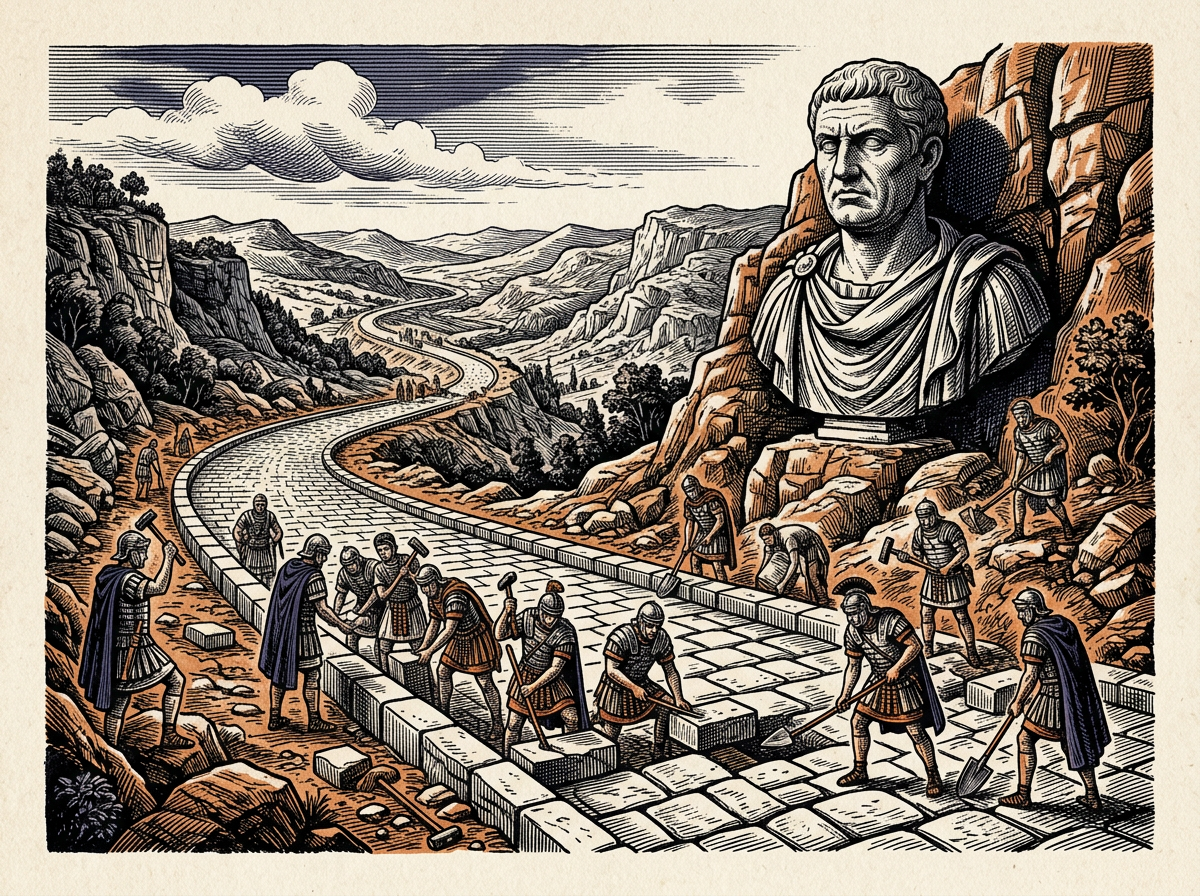
SYSTEMIC CONTROL: FORCED STABILITY
17 Nov 2026
Imperial pacification makes a poor model for modern organizational growth.
What is Pax Romana and How Did It Shape the Ancient World
Quick Summary: What You Need to Know
The Pax Romana, or "Roman Peace," was a transformative 200-year period of relative stability and prosperity that began in 27 BC under the rule of Augustus and lasted until 180 AD. During this era, the Roman Empire reached the height of its territorial reach and influence, effectively eliminating large-scale internal conflict across the Mediterranean. By enforcing a unified legal system and building an unparalleled infrastructure network, the Pax Romana turned a fractured collection of conquered territories into a singular, interconnected economic powerhouse.
Background & Essential Facts
The Pax Romana was not a period of absolute pacifism; the empire was still engaged in periodic border skirmishes and the occasional conquest. However, compared to the bloody civil wars that characterized the final years of the Roman Republic, this was an unprecedented golden age.
It began when Octavian—later known as Augustus—consolidated power after defeating Mark Antony and Cleopatra. By ending the systemic political chaos that had plagued Rome for decades, Augustus ushered in a new imperial model. This stability relied heavily on the professionalization of the Roman legions, which were repositioned from internal policing to securing the limes (frontiers) of the empire.
Spanning roughly 2.5 million square miles at its peak, the empire included regions as diverse as Roman Britain, the deserts of Mesopotamia, and the fertile plains of North Africa. The Roman state fostered a "Romanization" process, where local elites were encouraged to adopt Roman customs, architecture, and language in exchange for political status and safety. This created a remarkably durable, albeit authoritative, social order that allowed for centuries of sustained development.
How To Take Action / What To Do
STEP 01: Research Historical Timelines
To understand the Pax Romana, you must look at the succession of leaders who maintained it. You can map out this timeline by focusing on the transition from the Julio-Claudian dynasty to the "Five Good Emperors."
- Study the Anchors: — Start with Augustus (27 BC – 14 AD), who established the structural framework. Contrast this with the end-point defined by the death of Marcus Aurelius in 180 AD.
- Identify the "Good Emperors": — Focus your research on the period from 96 AD to 180 AD (Nerva, Trajan, Hadrian, Antoninus Pius, and Marcus Aurelius). This era is often cited as the peak of the Pax Romana.
- Visualize the span: — Create a timeline that marks major expansion events (like Trajan’s conquest of Dacia) alongside periods of consolidation. Seeing the transition from active conquest to defensive border maintenance is key to understanding how the peace was held.
STEP 02: Analyze Trade Expansion
The Pax Romana functioned like a ancient precursor to the modern global economy. To understand how this expansion worked, look at how the Romans eliminated the "friction" of international trade.
- Examine Maritime Security: — The Roman Navy cleared the Mediterranean of pirates, who had previously crippled merchant shipping. By turning the Mediterranean into a "Roman Lake" (Mare Nostrum), shipping became safer, faster, and cheaper.
- Trace the Road Networks: — Research the Via Romana. These roads were not just for soldiers; they were the "internet cables" of the ancient world. Track how a merchant in Londinium could theoretically reach Alexandria using a unified system of roads, bridges, and secure outposts.
- Investigate Commercial Standardization: — Look into the Roman monetary system. The widespread circulation of the denarius—a silver coin accepted from Spain to Syria—removed currency barriers, allowing for the rapid growth of complex commercial networks.
STEP 03: Evaluate Cultural Integration
The true genius of the Pax Romana was its ability to integrate diverse cultures into a single political identity. To evaluate this, look at how the Romans used "soft power" to maintain control.
- Assess Legal Uniformity: — Research the evolution of Roman law. How did the Jus Gentium (law of nations) allow Rome to manage legal disputes between citizens and non-citizens across different provinces? Understanding that law became a tool for stability, rather than just punishment, is vital.
- Observe Architectural Branding: — Look at the distribution of Roman architecture. Whether in Nîmes, France, or Leptis Magna, Libya, the presence of the amphitheater, the basilica, and the bathhouse served to make local populations feel like "Romans."
- Analyze Language and Policy: — Investigate the role of Latin and Greek as lingua francas. By promoting these languages, the Empire created a unified intellectual marketplace where news, administrative decrees, and philosophy could spread unimpeded by linguistic borders.
Key Takeaways
- Stability is a Force Multiplier: — The Pax Romana proves that even in an autocratic system, a long period of internal peace allows for exponential growth in trade, infrastructure, and cultural output.
- Infrastructure Equals Longevity: — The combination of a standardized, secure road network and the elimination of piracy in the Mediterranean created the first truly integrated, trans-continental economy.
- Cultural Integration is Essential for Control: — The Roman Empire succeeded not just through military might, but by creating a system where local elites felt invested in the success and legal structure of the central government, effectively turning conquered subjects into "Romans."
Chaff & Wheat Analysis
The Chaff: The article turns Rome’s relative stability into a seductive growth formula: centralize authority, standardize systems, and integrate people into a shared identity. That framing understates conquest, slavery, unequal rights, and recurring conflict—and does not establish that authoritarian control produces exponential growth.
The Wheat: Reliable infrastructure, predictable rules, and reduced disruption can support cooperation and exchange, but their benefits depend on who participates, who gains, and who bears the costs. Modern organizations can pursue those advantages through accountable leadership and meaningful participation rather than treating imperial pacification as a management model.
Related dispatches
MODERN RESTRAINT: CURBED ENTITLEMENT · The Bend Index
Moderation is not puritanism: finding humility in an age of impulse
25 Nov 2026
TACTICAL OVERSIGHT: POWER DYNAMICS · The Bend Index
Setting boundaries requires the leverage to survive their enforcement
25 Nov 2026
FALSE METAPHOR: EFFORTLESS ATTRACTION · The Bend Index
True magnetism requires an external strike, not passive alignment
25 Nov 2026
LEISURE DRIFT: PRESCRIPTIVE CONSUMPTION · The Bend Index
When mindless entertainment is repackaged as an actionable life protocol
24 Nov 2026