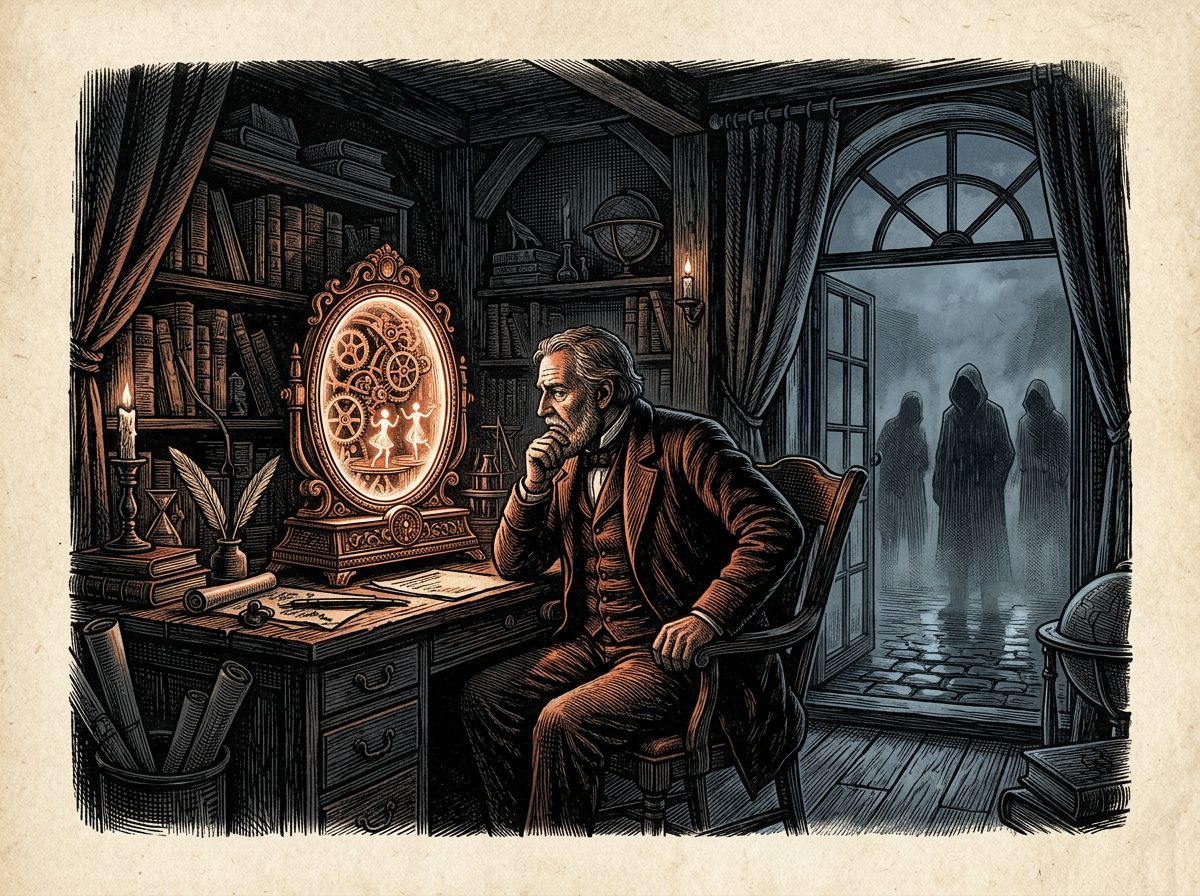
FAULT LINE: ARTIFICIAL GAZE
17 Nov 2026
Why the exhausting friction of human connection drives our digital retreat
The Solitary Default: Reexamining Human Connection, the Maternal Gaze, and Digital Solipsism
Are We Naturally Loners? The Psychology of the Gaze, Anxiety, and the Digital Escape
Abstract
Modern psychosocial discourse frequently characterises chronic loneliness as an unprecedented public health emergency. However, this academic and cultural framing contrasts sharply with alternative psychoanalytic and evolutionary perspectives which propose that solitude is the natural human baseline, whereas social engagement functions as an anxiogenic, metabolically costly adaptation. This study explores the theoretical framework articulated by psychologist Prof. Sam Vaknin regarding the "gaze" as the foundational anchor of the self, contextualises it alongside classical attachment theory (John Bowlby) and evolutionary models of perceived social isolation (John T. Cacioppo), and investigates how digital media and artificial intelligence have enabled a "cost-free" artificial gaze that fosters modern narcissistic solipsism.
Introduction: The Paradox of Modern Loneliness
Contemporary sociological data and public health institutions, such as the U.S. Surgeon General’s advisory on the epidemic of loneliness, treat isolation as a pathological deficit (Holt-Lunstad et al., 2015). Within this prevailing paradigm, humans are categorised as obligate social creatures whose well-being depends on continuous interpersonal integration.
However, psychoanalytic theorist Sam Vaknin presents a radical inversion: aloneness may be the natural human state, while socialisation represents an abnormal, highly taxing condition that provokes existential anxiety (Vaknin, 2025). To evaluate this proposition critically, this paper examines the mechanics of identity formation through the "gaze," the physiological and psychological costs of interpersonal friction, and the evolutionary and digital shifts reshaping human relational architecture.
Theoretical Framework: The Gaze, the Self, and the Primal Wound
- The Internalised Gaze as the Foundation of Identity
In psychoanalytic theory, the human "self", defined as a sense of continuity across space and time despite fluctuating circumstances, is not an autonomous, self-generated phenomenon. Instead, it is constructed through the internalised gaze of the "Other" (Lacan, 1977; Vaknin, 2025).
Without an external observer or reflective mirror, human identity risks dissolving into a diffuse psychological void. The self requires boundaries, and these boundaries are historically carved out through external recognition.
- The Maternal Mirror and Separation Trauma
This dynamic originates in early infancy. During the initial symbiotic phase, an infant and primary caregiver (traditionally the mother) exist in an undifferentiated fusion ("one organism with two heads") (Mahler et al., 1975).
- The Mirroring Realisation — When the infant first apprehends itself in the mother's eyes, it realises that the mother is a distinct, autonomous agent (Bowlby, 1969).
- The Primal Wound — Vaknin argues that this realisation of separateness is the foundational trauma of human existence. Introducing a permanent chasm between internal subjective reality and the external world, the gaze forces a lifelong confrontation with isolation.
Theoretical Comparison: Vaknin, Bowlby, and Cacioppo
To fully grasp how modern psychology diverges on the fundamental nature of connection, we can examine how Sam Vaknin’s psychoanalytic model, John Bowlby’s attachment theory, and John T. Cacioppo’s evolutionary model evaluate baseline human orientation, interpersonal contact, and relational resolution.
Regarding the default human state, the three models offer sharply contrasting premises. Vaknin’s psychoanalytic framework posits that aloneness is the natural baseline; within this view, socialisation is not an intrinsic biological drive but an acquired, anxiety-inducing economic cost endured solely to maintain ego boundaries and prevent identity diffusion (Vaknin, 2025). Conversely, Bowlby’s attachment theory asserts a model of relational dependency, arguing that human infants are biologically wired from birth for proximity-seeking and secure attachment to a primary caregiver, making connection a fundamental developmental necessity (Bowlby, 1969). Expanding this into an evolutionary domain, Cacioppo’s model frames humans as obligate social animals whose social connection operates as a homeostatic need just as vital as hunger or thirst (Cacioppo & Hawkley, 2009).
These divergent baselines shape how each theory interprets the nature of interpersonal contact. Vaknin characterises human contact as inherently anxiogenic, where every external gaze forces a confrontation with unbridgeable separateness, reviving primal maternal separation trauma and generating existential angst (Vaknin, 2025). In contrast, Bowlby views contact through the lens of emotional regulation: secure attachment buffers stress and provides co-regulation, whereas insecure patterns generate chronic distress and hypervigilance (Bowlby, 1973). Cacioppo bridges psychological and physiological mechanisms by describing contact as threat-calibrated, where positive connection fulfils evolutionary safety requirements, whereas perceived social isolation triggers unconscious neural hypervigilance against social threat (Cacioppo et al., 2006).
Finally, the models diverge significantly in how individuals resolve relational friction. According to Vaknin, interpersonal strain leads to psychological withdrawal, isolation, and the modern substitution of human interaction with a "cost-free" machine or digital gaze (Vaknin, 2025). Bowlby’s framework suggests that individuals adapt through internal working models, working through ambivalence or avoidance to refine their relational strategies and seek renewed emotional connection (Bowlby, 1973). Meanwhile, Cacioppo’s evolutionary perspective emphasizes behavioral reconnection, where innate drives motivate the individual to seek social repair, mend coalition ties, and restore social homeostasis within the group (Cacioppo & Hawkley, 2009).
- The Anxiogenic Cost of Socialisation
If the intersubjective space, the psychological bridge between two minds, is fundamentally unbridgeable, every human interaction carries an invisible psychological tax.
- Re-experiencing Separation Trauma — Every time an adult is gazed upon or enters an interpersonal exchange, ancient echoes of the maternal separation trauma reverberate, provoking existential angst (Vaknin, 2025).
- The Anxiety-Depression Loop — Because prolonged interpersonal friction generates chronic anxiety, and chronic anxiety degrades affective stability, the human mental apparatus naturally begins to code other people as stress triggers.
- The Price of Admission — Humans socialise not because it is intrinsically effortless, but because it is the mandatory price required to maintain a cohesive, bounded identity through external reflection.
- The Digital Revolution — The Artificial Gaze and Narcissistic Solipsism
Over the past two decades, the proliferation of digital platforms, social media algorithms, and generative artificial intelligence has altered the traditional economics of the gaze.
- The Cost-Free Gaze — Traditional human interaction demands emotional compromise, conflict negotiation, and tolerance of interpersonal friction. In contrast, algorithmic feeds and AI entities offer a non-human, artificial gaze that requires zero emotional overhead (Vaknin, 2025).
- Narcissistic Solipsism — By substituting genuine, face-to-face friction with simulated engagement and symbolic representations (introjection), individuals can maintain personal continuity and self-perception without ever confronting real human otherness. This accelerates a shift toward solipsistic withdrawal, where reality is rejected in favor of a controlled, self-contained fantasy loop.
Conclusion
While mainstream psychology and evolutionary biology emphasize human connectivity as a biological imperative (Cacioppo & Hawkley, 2009), Sam Vaknin’s framework offers a compelling counter-thesis: the burden of maintaining an ego under the gaze of unpredictable humans makes solitude an attractive psychological refuge. The rise of digital and artificial validation structures suggests that modern humans are increasingly choosing the frictionless, cost-free artificial gaze over the high-anxiety tax of traditional community.
References
- Bowlby, J. (1969). Attachment and Loss: Vol. 1. Attachment. Basic Books.
- Bowlby, J. (1973). Attachment and Loss: Vol. 2. Separation: Anxiety and Anger. Basic Books.
- Cacioppo, J. T., & Hawkley, L. C. (2009). Perceived social isolation and cognition. Trends in Cognitive Sciences, 13(10), 447–454.
- Cacioppo, J. T., Hawkley, L. C., Ernst, J. M., Burleson, M., Berntson, G. G., Nouriani, B., & Spiegel, D. (2006). Loneliness within a nomological net: An evolutionary perspective. Journal of Research in Personality, 40(6), 1054–1085.
- Holt-Lunstad, J., Smith, T. B., Baker, M., Harris, T., & Stephenson, D. (2015). Loneliness and social isolation as risk factors for mortality: A meta-analytic review. Perspectives on Psychological Science, 10(2), 227–237.
- Lacan, J. (1977). Écrits: A Selection (A. Sheridan, Trans.). W. W. Norton & Company.
- Mahler, M. S., Pine, F., & Bergman, A. (1975). The Psychological Birth of the Human Infant: Symbiosis and Individuation. Basic Books.
- Vaknin, S. (2025). Are We Naturally Loners? (Clip: Narcissism Summaries Channel) [Video file]. YouTube.
Chaff & Wheat Analysis
The Chaff: The article challenges the idea that connection should feel effortless and solitude always signals a problem. But its counterclaim—that humans are naturally loners and AI offers a psychologically cost-free substitute—turns a speculative psychoanalytic account into an overly broad explanation.
The Wheat: Social contact can be demanding, especially when it feels unsafe or evaluative, while chosen solitude can restore energy; neither makes chronic loneliness harmless or connection unnecessary. The useful distinction is whether solitude and digital engagement support recovery and reciprocal relationships or become ways to avoid them.
Related dispatches
MODERN RESTRAINT: CURBED ENTITLEMENT · The Bend Index
Moderation is not puritanism: finding humility in an age of impulse
25 Nov 2026
TACTICAL OVERSIGHT: POWER DYNAMICS · The Bend Index
Setting boundaries requires the leverage to survive their enforcement
25 Nov 2026
FALSE METAPHOR: EFFORTLESS ATTRACTION · The Bend Index
True magnetism requires an external strike, not passive alignment
25 Nov 2026
LEISURE DRIFT: PRESCRIPTIVE CONSUMPTION · The Bend Index
When mindless entertainment is repackaged as an actionable life protocol
24 Nov 2026